Last Updated on August 24, 2026 by Umar Farooq
A cold water pipe running with beads of water is not a plumbing fault. Nothing is escaping the pipe. The water on the outside came out of the air in your basement.
That distinction matters, because it changes what you are fixing. You are not repairing a pipe. You are dealing with a basement whose air holds more moisture than its cold surfaces can tolerate.
The pipe is a thermometer you already own
This is the useful part, and no other page on this topic seems to say it.
A cold water supply pipe is the one surface in your basement whose temperature you can predict without measuring. It runs at roughly the temperature of the water inside it, which is roughly the temperature of the ground your supply comes through.
So when that pipe sweats, it has told you something specific: the dew point of your basement air is higher than the pipe. That is a reading, not a defect. It is the cheapest diagnostic instrument in the room.
Sweating pipes do not add moisture to a basement. They pull it out of the air and make it visible. The moisture was already there.
The two numbers
Every article on this subject says a pipe sweats when it is colder than the dew point. Almost none tells you what either number actually is, which leaves you with a slogan instead of a test.
| Number | Typical value | Where it comes from |
|---|---|---|
| Cold water supply temperature | About 55–58 °F | The federal water heater test procedure fixes inlet water at 58 °F for testing. Shallow groundwater sits within a few degrees of the local mean annual temperature, so colder climates run lower. |
| Basement dew point, summer | Often 62–68 °F | At 68 °F and 70% relative humidity the dew point is about 58 °F. At the same temperature and 30% humidity it drops to about 35 °F. |
To check your own case, measure the air temperature and relative humidity in the basement with a cheap hygrometer, then convert to a dew point. The Department of Energy publishes a free moisture calculator that does the conversion. If the dew point comes out above about 55 °F, your cold pipes will sweat.
Is it condensation or an actual leak?
These get confused constantly and the fixes have nothing in common. Four checks separate them.
| Check | Condensation | Leak |
|---|---|---|
| First thing in the morning, before anyone has run a tap | Pipe is dry or drying. It only goes cold after water moves through it. | Still wet. Water is moving overnight, which means it is escaping somewhere or a toilet is running. |
| Distribution along the pipe | Even along the whole cold run | Concentrated at a joint, fitting or valve |
| Position relative to the drip | Beads form above and below the pipe, all the way round | Water appears below only. Gravity does not run upward. |
| Plastic taped over the wet area, sealed at the edges, left a few hours | Wet on the room-facing side | Wet on the pipe-facing side |
One case that fools people: a running toilet. A fill valve that never quite shuts keeps pulling fresh cold water through the line and into the tank, which keeps both cold enough to condense. Fix the toilet before you diagnose anything else, or you will be chasing a symptom you are manufacturing.
Insulating the pipe, in the way that actually works
Insulation is the permanent fix. It is also the thing most people get wrong, in a way that makes the situation worse rather than better.
The failure mode
Foam sleeve goes on. Seams are left unglued, or taped on the outside only. Water vapour moves through the gap, reaches the pipe, and condenses there. Now the water is against the metal, hidden from view, and permanent.
Industry guidance is direct about this. If the insulation is porous, vapour finds its way through and condenses on the pipe regardless of how thick the insulation is, so a vapour retarder is not optional. Any gap in the insulation, or any small opening in that vapour retarder, will produce condensation.
The installation rule is equally direct: longitudinal seams, butt joints and termination points must be glued with the manufacturer’s adhesive, both for adhesion and to create a vapour seal. Tape alone over unglued seams, or zip ties, is named as a common cause of failure.
Doing it properly
- Dry the pipe first. Insulation fitted over an actively sweating pipe gets wet immediately and its performance drops away.
- Size the sleeve to the pipe. A loose sleeve leaves an air gap that will condense.
- Glue every seam, both the long split and every butt joint, with the adhesive the manufacturer specifies.
- Use pre-formed elbows and tees, and seal them to the straight runs. Fittings and valves are where most installations leave bare metal.
- Seal the ends where the insulation stops. An open end is a route in.
- Tape over the glued seams afterwards for durability, not instead of gluing.
The 3/8 inch sleeve is the wrong product
The thin foam sleeve sold in every hardware store is an energy product. It is sized to slow heat loss from hot water pipes, which is a different job.
Insulation trade commentary on the ASHRAE thickness tables makes the distinction explicitly: those thicknesses were determined for energy conservation, not for condensation control, which often requires more than an inch, particularly on pipes running through unconditioned spaces. A basement in summer is an unconditioned space.
There is a second reason thickness matters. Insulation works by keeping the outer surface warmer than the dew point. Too thin, and the outside of the insulation lands below dew point instead. You have not stopped the sweating, you have moved it half an inch outward.
And once insulation is wet it stops insulating. Reported figures put the loss at around 7.5% of thermal value for every 1% of moisture taken up, with conductivity rising steeply at higher moisture content. That produces a loop: wet insulation conducts better, the surface gets colder, more condenses.
Will a dehumidifier fix it?
It can, but the target most people aim at is not tight enough.
The EPA advice is to keep indoor humidity below 60 percent, ideally between 30 and 50 percent. Those two ceilings behave very differently here. A basement at 70 °F and 60% relative humidity has a dew point around 55 °F, which is right at the pipe temperature. At 50% it drops to roughly 50 °F and the pipe stays dry.
So aiming at “under 60%” will often still give you sweating pipes. Aiming at 50% will not. If you are running a dehumidifier for this reason, that is the number to set.
Two limits worth knowing. Refrigerant dehumidifiers lose capacity as temperature drops and struggle below about 60 °F. And a dehumidifier is a running cost forever, whereas insulation is a one-off. If the pipes are the only problem, insulate. If the whole basement is humid, you probably need both, and you should also find out where the moisture is coming from.
What does not work
- Spray-on “anti-sweat” coatings. A paint film is far too thin to lift a surface above the dew point. Regulators have taken action against insulating-coating makers for overstated R-value claims more than once.
- Fibreglass wrap with no vapour retarder. Vapour passes straight through and condenses on the pipe. Wet fibreglass in a basement is also a mould problem you cannot see.
- Opening the windows. In humid weather you are importing moisture. Warm outdoor air meeting cold basement surfaces condenses rather than dries.
- Wiping the pipes. Obvious, but people do it for weeks. The air will replace it within the hour.
When sweating pipes are telling you about a bigger problem
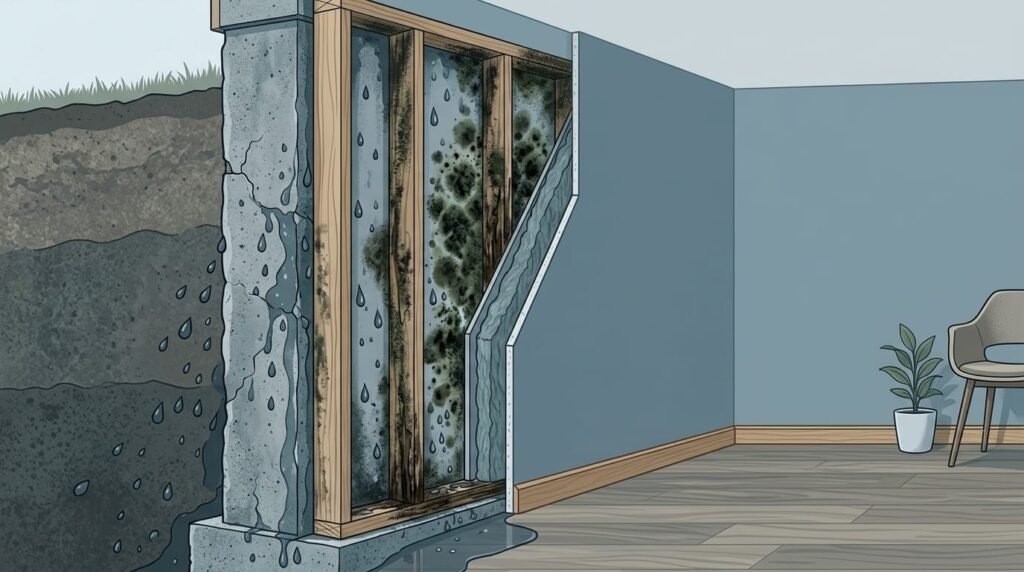
If your pipes sweat, your basement air has a high dew point. The pipes are simply the coldest thing available. Everything else cold in that room is doing the same thing more quietly: the floor slab, the bottom of the walls, the rim joists, the underside of stored boxes.
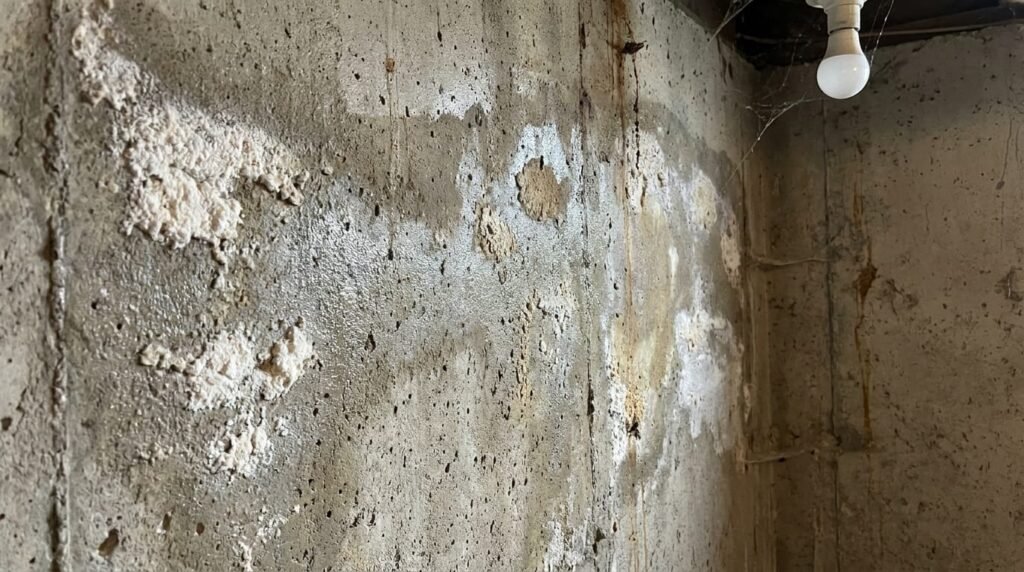
Insulating the pipes removes the visible symptom and leaves the rest. That is fine if the humidity is ordinary summer humidity. It is not fine if the humidity is high because water is getting in somewhere, in which case the pipes were doing you a favour by showing you.
FAQ
Do sweating pipes cause mould?
The drips create wet spots on the floor and on anything stored underneath. In a humid basement those spots do not dry quickly, and mould establishes on organic material like cardboard or timber within a couple of days.
Why do my pipes sweat in summer but not winter?
Winter air holds far less moisture, so the dew point falls below the pipe temperature and nothing condenses. If yours sweat in winter as well, the moisture source is inside the basement rather than the outdoor air.
Will insulating cold pipes make them freeze?
No. Insulation slows heat transfer, it does not chill the pipe. In an uninsulated basement, insulated cold pipes are marginally less prone to freezing, not more.
Do drain pipes sweat too?
They can, for a different reason. A cold supply pipe is cold because of the water in it. A plastic waste pipe goes cold from cool water passing through and from air moving in the stack. The fix is the same, but a sweating drain does not indicate anything about your water supply.
How much water is coming off them?
Less than it looks. A continuously wet run of pipe produces on the order of a pint a day, which is a small fraction of what a dehumidifier removes from the same room. The pipes are a symptom of the moisture load, not the load itself.