Last Updated on August 25, 2026 by Umar Farooq
Search this and you get storage bins. The people who actually know the answer are archivists and museum conservators, whose job is keeping paper, photographs and textiles alive in imperfect buildings, and who have published precise numbers for decades.
Two things come out of that literature that no consumer page will tell you. The first is that a sealed plastic bin is not the answer, and a national library says so in as many words. The second is that the correct humidity for your tools and the correct humidity for your photographs are different numbers, so no single setting protects everything down there.
The plastic bin question, answered by the Library of Congress
This is the central recommendation of every page competing for this search, and it is addressed directly in a national library’s own FAQ, under a question phrased almost exactly the way you would ask it.
Read that last sentence twice. A sealed bin in a damp room does not keep the damp out. It seals the damp in, at whatever humidity the room was when you closed the lid, and then holds it there against the contents.
The bin is flood protection. It is explicitly ranked as secondary, behind not putting the thing in a high-risk place at all.
And a gasketed lid does not fix it either. Conservation guidance notes that a polyethylene or polypropylene container with a silicone gasket is moisture permeable, and humidity slowly leaks through the seal over time.
The numbers, by material
Here is the thing nobody puts side by side.
| What you are storing | Published target | Source type |
|---|---|---|
| Paper and documents | Room temperature or below, about 35% RH | National library |
| Books | 70 °F or below, 30 to 55% RH | National library |
| Photographic prints | 30 to 50% RH, 70 °F or below | National library |
| Colour photographs and film negatives | 40 °F or below. Temperature is the controlling factor here, not humidity | National library |
| Magnetic tape | Room temperature or below, 35 to 40% RH | National library |
| Textiles | About 45% RH, around 70 °F | National museum group |
| Metal objects and tools | Below 35% RH | National park service |
| General mould prevention | Never above 65% RH. Target 45 to 55% | National archives |
So the honest conclusion, which no page selling storage bins will reach: the humidity that merely avoids mould on your books is already well inside the corrosion range for your tools. If you keep both down there, you are choosing which one to protect.
The one number to remember
If you take one figure away, take 65 percent. Museum guidance recommends that relative humidity not rise above 65%, and archives guidance says spore germination is less likely between 45% and 55% but that humidity should be kept below 65%, with dehumidifiers needed above it.
But note the caveat, because it is what makes this honest rather than a slogan. Those are described as maximum levels that only reduce the potential for microorganism growth. They do not eliminate the threat, and some organisms grow at lower temperatures and lower humidity. 65 is the do-something line. 45 to 55 is the target.
Why a cool basement is a damp basement
This is the mechanism that makes everything above make sense, and it is missing from every consumer page on the subject.
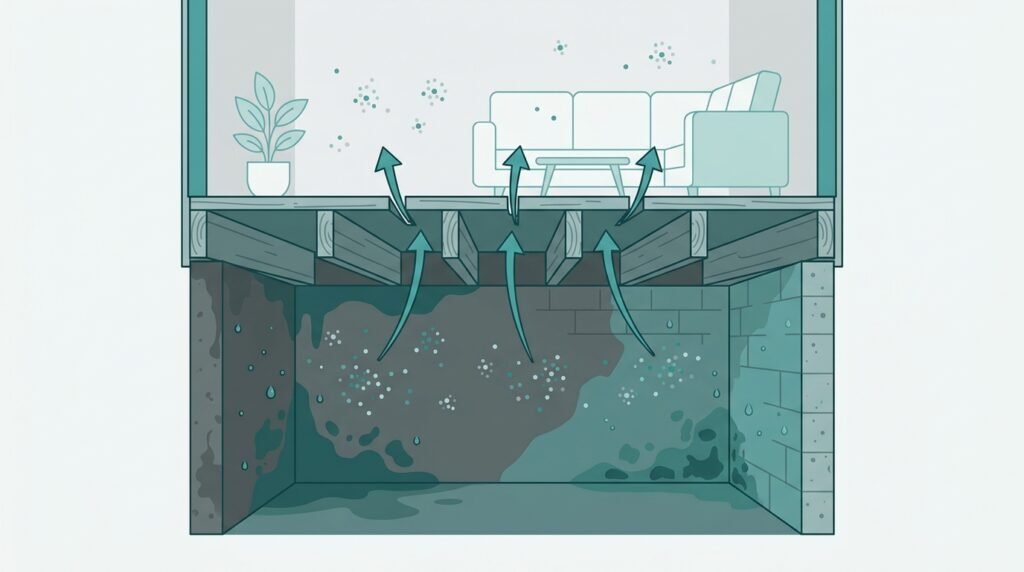
The same air, carrying the same amount of water, reads as higher humidity when it is colder. Your basement is the coldest room in the house. That is not a coincidence alongside the dampness; it is a cause of it.
The same guidance warns that institutions trying to improve conditions by lowering storage temperature without watching the resulting humidity may find the moisture level is much too high. Cool storage sounds protective and is only protective if you are controlling humidity at the same time.
It also explains why an exterior wall is the worst place to stack boxes. It is the coldest surface in the room, so it is where moisture condenses first. Conservation guidance names exterior walls in the same breath as attics and basements as locations with high risk of condensation.
Stability matters as much as the level
Genuinely non-obvious, and consistent across the conservation literature. It is not only how damp it gets, it is how much it moves.
Ideally, RH fluctuations should be less than 5% within a 24 hour period.
Guidance on books makes the same point, advising against areas with frequent extreme swings in temperature or humidity, because stable conditions slow ageing and protect against physical stress on the binding.
A basement that sits at 60 percent all year is kinder to your possessions than one that swings between 45 and 75 with the seasons. Materials absorb and release moisture as conditions change, and that movement is itself the damage.
What is actually happening to your things
Mould, and why drying it out is not the end
The most important thing to understand about mould on possessions is that killing the conditions does not kill the mould.
So “it dried out and it was fine” is a false all-clear. The colony is waiting for next summer.
Archives guidance is also clear that the damage is permanent: microorganisms produce irregular stains that can permanently damage an object, and will stain textiles and decrease the strength of the fabric. Cellulose materials such as cotton, linen, paper and wood, and protein materials such as leather, are particularly susceptible.
Those brown spots on old paper have a name, incidentally. The scattered spots known as foxing on paper prints or drawings are damage resulting from these growths.
Photographs stick to the very sleeves you bought
Seventy percent. Above that the emulsion can fuse to the sleeve, and the photo is gone when you try to separate them. Note the order of failure in a damp basement: you hit the mould threshold at 65 first, then blocking at 70.
Damp also makes prints stick to each other, which is why a shoebox of loose photographs in a damp basement is a worse idea than it looks.
And the things that eat the rest
Damp storage feeds pests as well as mould, and the same humidity number covers both. Archives guidance advises keeping relative humidity below 65% to prevent mould growth and reduce insect activity, and preservation research notes that as conditions warm and dampen, insects eat more and breed faster while mould growth increases.
Paper and starch-based bindings are exactly what silverfish feed on, which is why a box of documents in a damp basement tends to acquire both problems at once. There is also a loop worth knowing: certain mites feed on fungi and carry spores onto normally resistant materials, and as the mites die they become the nutrients for a new fungal colony.
Metal, and a feedback loop worth knowing
Iron and copper alloy objects are described as especially vulnerable, with corrosion reactions that can develop rapidly, and the recommendation is to keep metal objects below 35% relative humidity.
And mould attacks metal too. As a by-product, fungi can produce organic acids that corrode and etch inorganic materials. Your damp basement is running two processes on your tools at once.
What actually works
Get it off the floor, with a real figure
Conservation furniture guidance specifies erecting storage with six inches between the unit and the floor, and gives two reasons: to allow vacuum cleaning underneath, and to protect against water intrusion.
That second reason is the one everyone knows. The first matters more than people think, because dust and debris under a stack is where pests live.
You will also read that concrete wicks moisture up into cardboard. We could not find a conservation or government source for that specific mechanism, only vendors, so we are citing the off-the-floor rule for the reasons it actually has.
Shelving, and two details that surprise people
- Metal, not wood. Metal shelves are preferable because the acids present in wood can migrate into paper and books and cause deterioration. Existing wood shelves can be lined with polyester film, corrugated polyethylene or polypropylene board, metal foil laminate, acrylic sheet or glass.
- Solid, not wire. Guidance is explicit that shelves should have a solid surface, not latticed or slatted, and should be flat with no protrusions such as splinters or nails. The wire shelving the internet recommends for airflow is not what conservators use.
- Books stand up, and never spine up. Books should never be stored spine up, because over time gravity will cause the text block to loosen or detach from the cover. Too large to stand? Lay it flat, fully supported.
Enclosures
If you are using plastic, the acceptable materials are named: polyethylene, polypropylene or polyester without additional slip or coating agents are considered stable and inert. Avoid PVC, which generates acids that fade photographs, and can stick to items inside and transfer the image onto the plastic.
For paper, the specification is acid- and lignin-free folders and boxes, alkaline buffered or neutral pH, because buffering neutralises the acids inherent in ageing paper. Ordinary cardboard is neither of those things, and it is also direct mould food.
Desiccants, and the arithmetic that settles it
The sachet-in-the-box advice does not survive contact with the published dosage.
Silica gel can absorb up to 40% of its weight in moisture. The working ratio conservators use is a quarter to half a pound of gel per cubic foot of enclosed space.
A standard 27 gallon storage tote is around three and a half cubic feet. That is roughly one to two pounds of silica gel per box, not a five gram packet. And it only works sealed: the guidance is explicit that silica gel can only maintain a microenvironment in a well-sealed enclosure.
Two safety notes from the same source, since people handle this stuff casually. Never let silica gel come into direct contact with the objects, and use a dust mask and gloves when working with it, because the dust can cause lung damage.
Dehumidify, and the target
This is the one concession the conservation world makes to a basement, and it is worth having:
So a basement can be made acceptable. Guidance elsewhere says dehumidifiers become necessary above 65% humidity, and the ongoing target for collections is 35 to 50 percent.
The same source names the alternative, which is more useful than a flat prohibition: above ground interior closets maintain fairly constant temperatures throughout the year and should be considered for storage.
What does not belong down there at all
Some categories fail whatever container you put them in. Colour photographs and film negatives, because they are governed by temperature rather than humidity. Leather and anything protein-based, which is directly attacked. Tools and anything ferrous, which want a humidity far below what the room will hold. And tinned and dry food, which is a separate calculation with its own numbers.
For anything irreplaceable, copy it
Digitising lets you view and share items without handling them, which itself causes damage. Two important qualifiers from the same guidance: keep the originals afterwards, because digital files have their own preservation risks, and follow the three copies, two media, one off-site rule.
If it gets wet
This section is the most useful thing on the page, because it is a genuine emergency procedure that no consumer page carries.
You have about 48 hours
The word to notice is “as little as”. The same guidance adds that reducing temperature and humidity and increasing air circulation extends the time available before mould growth begins. So the first move is fans and a dehumidifier, and that buys you the window.
Put wet books in the freezer
This is a real, documented conservation technique and it is completely absent from consumer advice.
Better still, the annoying feature of a modern freezer turns out to be an advantage: a freezer with a frost-free setting can, over months, dry out items, which the guidance says can be preferable to air drying. Set it as cold as it goes.
How to pack them, from the same source. Wrap every other book in wax or freezer paper, glossy side in, spine down, with a piece cut one to two inches larger than needed. Ten to twelve books per box because of the weight, not packed too tightly, with crumpled paper filling any gap so nothing slumps.
Freeze glossy and coated paper immediately. That is the emergency case, because coated pages fuse into a solid block if they are allowed to dry stuck together.
What you must not freeze
Here is the genuinely counterintuitive part, and it inverts what anyone would guess.
| Item | What to do |
|---|---|
| Cased photographs — daguerreotypes, ambrotypes, tintypes | Never freeze. Air dry face up with the case open. Recovery rate is low and you must act immediately |
| Wet collodion glass plates | Never freeze. Air dry emulsion side up. Recovery rate is low |
| Anything with mixed or layered media, varnished maps, items glued to a support | Do not freeze |
| Ordinary photographs and negatives | Freezing is fine, and it is what saves them |
| Gelatin dry plate negatives | Freeze or dry within 48 hours. If freezing, keep them wet rather than drying them off first |
Air drying, done properly
- Drying space at or below 72 °F and ideally 30 to 60 percent humidity, using fans to circulate air.
- Do not aim the fans at the items. The guidance says so explicitly, and it is what everyone does wrong.
- Interleave with unprinted paper towel or newsprint. Printed ink transfers into wet paper.
- Support wet paper fully on a flat surface. It is heavy and fragile.
- On books: do not open or close them, and do not blot.
Expect permanent change even when it works. Air dried items may cockle and warp, may end up more fragile than before, and may need more shelf space than they did. A dried book is a fatter book.
When to stop trying
Conservation guidance is unusually honest about this, in a way no page selling storage products would be. The costs to stabilise and treat mouldy items can often exceed replacement costs, and if the item is replaceable, replacement should be considered.
If you do handle mouldy material: active mould looks fuzzy or slimy and should not be disturbed, dormant mould is dry and powdery, and removal should be done outdoors or into a vacuum with HEPA filtration rather than blowing spores back into the room. Wear a HEPA respirator and disposable gloves for anything badly infested.
Six things the internet tells you that are wrong
- “Put it in a sealed tote and it is safe.” Refuted by name above. The bin is flood protection, and sealing a container in a humid room increases mould risk.
- “Cardboard boxes are fine.” Ordinary cardboard is acidic, unbuffered, and is itself a cellulose food source for mould.
- “Use plastic sleeves for photos.” Not in an uncontrolled environment, where the emulsion can stick to them above 70 percent humidity. And never PVC.
- “Wire shelving for the airflow.” Conservation guidance wants solid shelves, not latticed or slatted.
- “A few silica packets will do it.” The published dose is a quarter to half a pound per cubic foot, in a sealed enclosure. A packet in an open box does nothing measurable.
- “It dried out, so it is fine.” The mould is dormant, not gone, and it resumes when conditions return.
One more, on the musty smell, because people ask. Over time musty odours decrease when items are stored with air circulation, not enclosed in a box, in cool conditions between 35 and 55 percent humidity. Which is the opposite of sealing them in a tub.
What to actually do this weekend
- Put a hygrometer down there for a week and record the highest reading and the swing, not the average.
- Move anything irreplaceable upstairs. Photographs, documents, anything with sentimental value. An above-ground interior closet is the named alternative.
- Get everything else six inches off the floor and away from exterior walls.
- Dehumidify to 45 to 55 percent if you are keeping things down there at all.
- Repack out of cardboard into polyethylene or polypropylene, understanding that the container is protecting against a flood rather than against the humidity.
- Digitise the irreplaceable things, keep the originals, and follow three copies on two media with one off site.
- Then fix the damp, because none of the above changes what the building is doing.
FAQ
Is a plastic tote better than a cardboard box?
Yes, but not for the reason people think. It is better flood protection and it is not itself acidic or edible. It does not control humidity, and sealing one in a damp room increases mould risk.
What humidity should I set the dehumidifier to?
45 to 55 percent is the conservation target, and never above 65. If you are storing tools or anything ferrous, they want below 35 percent, which is a different setting again.
Can I store photographs down there if it is dehumidified?
Black and white prints, at 30 to 50 percent humidity, at a stable temperature, yes with care. Colour photographs and film negatives want 40 °F or below, which a basement will not give you, so those belong somewhere else or in a freezer designed for the purpose.
My books smell musty but look fine.
Air circulation in a cool space at 35 to 55 percent humidity reduces the odour over time. Do not seal them in a container to contain the smell, which is the instinct and makes it worse. Check them for fuzzy or powdery growth first.
Everything got soaked. What do I do first?
Fans and a dehumidifier immediately, because that extends the window before mould starts. Then triage: freeze anything paper you cannot air dry within two days, air dry cased photographs face up straight away, and accept that replaceable items may not be worth the effort.
Are those moisture absorber tubs from the hardware shop any use?
At container scale, in a sealed box, a desiccant can hold conditions for a while. At room scale in an unsealed basement, compare the published dose, a quarter to half a pound per cubic foot, against the volume of your basement and the answer becomes obvious.