Last Updated on August 25, 2026 by Umar Farooq
White powder, chalky crust, or a fine crystalline bloom on a basement wall or floor. Most people arrive here with one question first, so let us deal with it immediately.
Is it mould?
Almost certainly not, if it is on bare masonry, concrete or mortar. Mould is a fungus and it needs organic material to feed on. Bare concrete and brick offer it nothing.
A white deposit emerging from masonry is a mineral salt. White growth on top of timber, drywall paper, cardboard, paint or a film of dust can be mould, because those are organic. The substrate settles it faster than any other test.
| Check | Mineral deposit | Mould |
|---|---|---|
| What it is growing on | Bare masonry, concrete, mortar — it emerges from the material | Organic material: timber, paper, cardboard, paint film, dust |
| Crushed between finger and thumb | Gritty, crystalline, like fine salt | Soft, fuzzy, filamentous; may smear |
| Smell | None | Musty — a damp basement smell |
| Spray with water | Usually dissolves and disappears — but see the warning below | Unchanged, may smear |
| Over time | Returns in the same place after drying | Spreads outward and colonises new area |
One caution on the substrate test, because it is not quite absolute: mould cannot feed on concrete or brick itself, but it can feed on a layer of dust or dirt sitting on bare masonry. So masonry is strong evidence rather than proof — it needs to be masonry and gritty and dissolve.
And please do not use the taste test that circulates online. You do not yet know what the deposit is.
The water test everyone publishes is incomplete
Nearly every page on this subject tells you: if it dissolves in water it is efflorescence, if it does not it is mould. That advice is wrong in a way that matters, because several white masonry deposits do not dissolve in water either.
The missing step is vinegar. Carbonate deposits — the lime salts — barely dissolve in water but do dissolve in a dilute acid. So the test has three outcomes, not two:
| Drop water on it, then vinegar | What it is |
|---|---|
| Dissolves in water | Efflorescence — soluble sulphate or alkali salts. |
| Resists water, dissolves in vinegar | A carbonate deposit — lime bloom or lime run. Still a mineral, still not mould. |
| Resists both | Now mould is a real possibility — or white scum, a silicate deposit left behind by acid cleaning. Check the substrate and the smell. |
| Deposit | How it looks | Dissolves? | What it means |
|---|---|---|---|
| Efflorescence | Fine, loose, powdery or fluffy crystalline bloom | Yes | Salts carried out of the masonry by moisture. Usually harmless in itself. |
| Lime run | Hard, crusty white or grey formation, often streaked downward from a crack, joint or weep hole | No — once carbonated it is insoluble | This is the one that matters. It indicates water running through a defined path, and it continues until that water source is stopped. |
| White scum | Dull white haze bonded to the surface | No | A silicate deposit left by acid cleaning — usually somebody already tried to clean this wall with muriatic or hydrofluoric acid. |
The irony is that the deposit everyone panics about is the harmless one, and the deposit that genuinely signals a live leak is the one the popular test misidentifies.
What efflorescence actually is
Three things have to happen at once, and removing any one of them stops it:
- Soluble salts are present in or in contact with the masonry.
- Water reaches those salts and dissolves them.
- A path and a driving force — a pore structure to travel through and evaporation pulling the solution to the surface, where the water leaves and the salt stays.
The salts are mostly sulphates and carbonates of sodium, potassium, calcium, magnesium and aluminium. They come from the brick, the mortar, the concrete, or the ground. On new concrete and mortar there is a specific reaction: calcium hydroxide from the cement is carried to the surface, meets carbon dioxide in the air, and becomes calcium carbonate — the whitish deposit.
It is a mineral, not a biological growth. Masonry industry technical guidance describes it as normally harmless and states that it does not affect structural performance. Nothing anywhere attributes health effects to it — which is worth saying plainly, because it is often photographed as though it were.
Read the pattern — it is a free diagnosis
Where and how the deposit sits tells you more than any test kit, and no page currently ranking for this gives you the decision table.
| Pattern | What it indicates | Action |
|---|---|---|
| Fairly uniform across the whole wall, building under a year old | New building bloom — normal water leaving the construction | Self-limiting. It gets lighter over time. Leave it. |
| Heavy streaks immediately below mortar joints or cracks | Water is entering the wall at a higher level and running down a defined path | Find the entry point. This one needs correcting. |
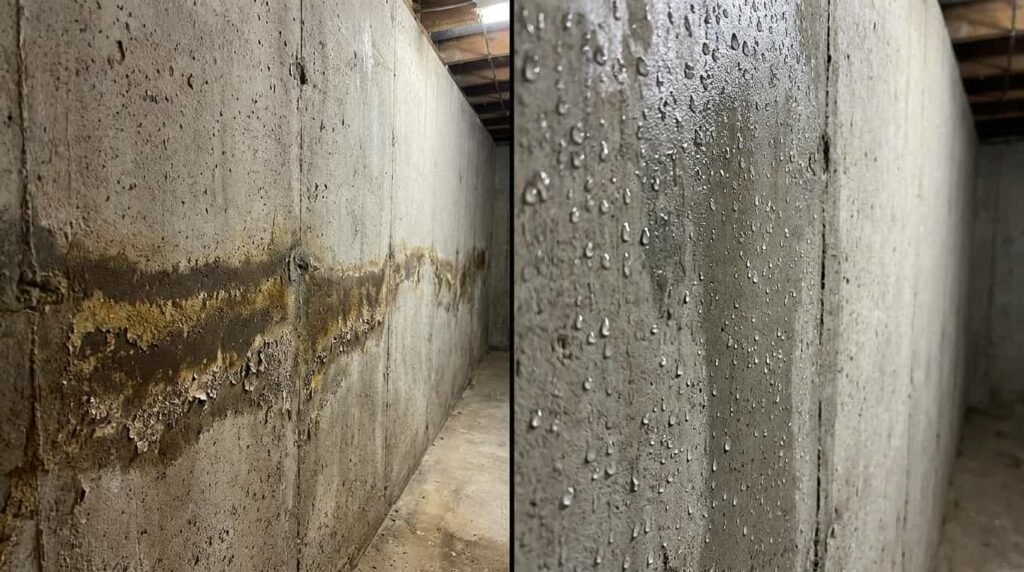
| Horizontal tide mark roughly 1–3 ft above the floor, fluctuating with the seasons | Capillary rise — moisture drawn up through the masonry, evaporating at that height | Investigate ground levels, drainage and any damp-proof course. |
| Appears more than a year after construction | Water penetration or poor drainage rather than normal drying | Treat as an active moisture problem. |
| Getting lighter each time it returns | The salt supply is being used up and no new water is arriving | Usually resolving on its own. |
| Worse in winter, better in summer | Normal. Slow winter evaporation lets more salt reach the surface; fast summer evaporation brings less | Not a sign of deterioration by itself. |
The salt nobody photographs
Here is the part that reframes this whole topic, and it comes from the trade body that represents damp-proofing contractors — not from a critic of the industry.
Salts which are visible as efflorescence are seldom hygroscopic and are usually sulphates.
The salts that genuinely indicate rising damp are chlorides and nitrates, and the same guidance notes they are seldom visible. They are hygroscopic, meaning they pull moisture straight out of the air — enough to make a wall visibly wet in humid weather and dry again when the air dries, entirely independent of any water rising from the ground.
The numbers are useful. Uncontaminated masonry holds less than 0.01% chloride or nitrate by weight. A wall genuinely affected by rising damp for some time reaches 1–2%. That is a laboratory measurement, not something visible on the surface.
So the visible white bloom — the photograph used to open a great many waterproofing quotes — is usually the wrong salt to be pointing at. It tells you moisture has moved through the wall at some point. It does not tell you that moisture is rising from the ground, and it is not evidence for the treatment most often sold on the back of it.
Why the visible bloom is the good version
This is genuinely counter-intuitive. Salt crystallising on the surface, where you can see and brush it away, means the evaporation front is at the surface. That is the harmless outcome, and slow-evaporation environments like basements and cellars tend to produce exactly that.
The damaging version happens when evaporation occurs inside the masonry. Salts then crystallise within the pores — subflorescence — and the pressure of crystal growth is high enough to disrupt strong masonry, producing crumbling, fretting, or whole skins of surface delaminating.
Which leads directly to the most common mistake:
Sealing or coating a wall to stop the white deposit appearing does not stop the salt. It moves the crystallisation inside the wall, where it does the damage.
Masonry technical guidance is explicit that coatings are not recommended as the sole treatment for efflorescence, noting that salts then deposit roughly an eighth to a quarter of an inch below the surface and can develop pressures sufficient to spall the masonry.
What not to do
Acid washing
The most commonly recommended “professional” fix, and the worst. National Park Service guidance on masonry states that muriatic (hydrochloric) acid should not be used on historic masonry because it dissolves lime-based mortar, damages brick and leaves chloride deposits on the masonry.
Masonry industry guidance is more specific still: lime reacts with unbuffered hydrochloric acid to produce very soluble calcium chloride, which can migrate to the surface and become efflorescence. The acid does not just fail to fix the problem — it manufactures fresh deposit.
Now connect that to the section above. Chlorides are the hygroscopic salts that pull moisture from the air and keep walls damp, and they are the salts a laboratory would look for to diagnose rising damp. Acid-washing therefore contaminates the wall with the exact salt type that causes persistent damp, and corrupts the evidence anybody would later use to diagnose the wall properly.
It can also leave you worse off cosmetically. Improper acid cleaning produces white scum — insoluble silicate deposits that are harder to remove than the efflorescence you started with. The deposit itself was harmless; the acid is the part with a hazard attached.
Pressure washing
Masonry guidance caps cleaning pressure at around 400 psi, describes anything above 800 psi as not appropriate for brick, and warns that high-pressure water can etch mortar joints and remove the outer surface of brick.
A domestic pressure washer typically runs 1,500–2,800 psi. That is between two and seven times the level the industry says is already too high. Beyond the physical damage, guidance notes that pressure forces cleaning solution deep into the masonry where it becomes a source of future staining — and the extra water brings more salt back out.
Washing it off in cold or damp weather
Guidance is that washing efflorescence off is not advisable except in warm, dry weather, precisely because washing adds moisture and can bring more salts out. Dry brushing first is the standard first step for a reason.
Sealing, painting or rendering over it
Covered above. Preservation guidance adds that a water-repellent coating should never be applied to a damp wall, and that sealing moisture into a wall can force capillary action higher up rather than stopping it.
Vinegar
Widely recommended online. It is an acid, applied unbuffered and usually unrinsed, and it attacks the calcium carbonate binder in mortar by the same mechanism as any other acid. No masonry technical authority recommends it.
One counter-intuitive thing about dehumidifiers
A dehumidifier is the standard advice for a damp basement, and it does reduce humidity and odour. But university extension guidance makes a point worth knowing: drying the basement air more aggressively increases the rate at which moisture is drawn into the basement through the masonry, which can produce more efflorescence and more spalling of concrete.
That is not an argument against dehumidifying. It is an argument against treating a dehumidifier as the fix. The same guidance is blunt that dehumidification reduces the symptoms rather than solving the problem, and that the right approach is almost always to control the source of the moisture rather than fight it at the last line of defence.
If it is on the floor rather than the wall
A slab is a different mechanism. There is no capillary rise up a wall to consider — instead moisture moves upward through the slab from the ground, which sits at essentially 100% humidity permanently, and evaporates at the top surface leaving salt behind.
A slab poured without a vapour barrier beneath it will do this indefinitely, because the supply of moisture never stops. If the deposit keeps returning on a floor after you clean it, and the pattern is broad rather than streaked, that is the likely explanation, and it is a slab problem rather than a wall problem.
What to actually do
- Work out which deposit you have using the table above. Lime run and efflorescence mean different things.
- Read the pattern before spending anything. Uniform and fading needs no intervention.
- Find and fix the water first. Masonry guidance from several independent sources says the same thing: establish the cause and correct it before removing the deposit, or you are just cleaning on a schedule.
- Then remove it dry. Stiff brush, warm dry weather, minimal water. Repeat as it recurs while the wall finishes drying.
- Do not seal it in. Let the wall keep evaporating at the surface.
And if somebody photographs the white bloom and quotes you for a damp-proof course on the strength of it, the questions worth asking are what salts they identified, how, and whether the pattern actually matches capillary rise.
FAQ
Is efflorescence dangerous to my health?
No. It is a mineral salt, not a biological growth, and no health authority attributes health effects to it. What is worth attention is the moisture that carried it there.
Does efflorescence mean I have a damp problem?
It means water has moved through the masonry at some point. Whether that is an active problem depends on the pattern and whether it is fading. Uniform bloom on a new build is normal; localised streaks that keep returning are not.
It keeps coming back after I clean it. Why?
Either water is still arriving, or the wall still has a lot of salt in it and is gradually purging while it dries. If it comes back lighter each time, it is the second. If it comes back the same or heavier, water is still getting in.
Can I just paint over it?
Painting over efflorescence traps the salt behind the coating, where crystallisation pressure can lift the paint and damage the masonry. Fix the moisture, let the wall dry and purge, then decorate.
How do I tell efflorescence from mould if the wall is painted?
Paint is organic, so both are possible. Check the texture — gritty and crystalline versus soft and fuzzy — and check for a musty smell. Bubbling or lifting paint with white crystals underneath usually points to salts pushing from behind.
Is white residue on the floor the same thing?
Chemically similar, mechanically different. See the floor section above — it usually points at moisture moving up through the slab rather than through a wall.