Last Updated on August 24, 2026 by Umar Farooq
If you search this question, almost every answer you find will be published by a company that sells basement waterproofing. That does not make them wrong. It does mean the page explaining how dangerous your basement is was written by the people who will quote you to fix it, and it shows — the claims get dramatic and the citations disappear.
This page does it the other way round. Everything below is graded by how strong the evidence actually is, including a section on the claims that are not supported. We sell nothing, so we have no reason to make this sound worse or better than it is.
The short version: yes, damp housing has real and well-documented effects on breathing, and the population-level burden is large. No, it does not cause memory loss, brain fog, chronic fatigue or cancer, and “toxic black mould poisoning” is not a recognised diagnosis. Both halves of that are true at once.
The evidence, graded
In 2004 the US Institute of Medicine reviewed the entire literature on damp indoor spaces and sorted every health outcome into tiers by evidence strength. The World Health Organization did the same exercise in 2009. This is the table that almost never appears in articles on this subject.
| Evidence tier | Health outcomes |
|---|---|
| Sufficient evidence of a causal relationship | Nothing. No health outcome met this bar for damp indoor environments. |
| Sufficient evidence of an association | Upper respiratory (nose and throat) symptoms · cough · wheeze · asthma symptoms in people already sensitised. Where mould is visible, also hypersensitivity pneumonitis in susceptible people. |
| Limited or suggestive evidence | Shortness of breath · lower respiratory illness in otherwise healthy children · development of asthma in susceptible people. |
| Inadequate or insufficient evidence | Neurological effects · cancer · fatigue · reproductive effects · acute idiopathic pulmonary haemorrhage in infants. |
Note what the top row says. Even after reviewing everything, the strongest tier came back empty. That is not a reason to dismiss the problem — the second tier is substantial and it is about your lungs — but it is a reason to be sceptical of anyone who tells you the science is settled and dramatic.
The strongest single finding: asthma
If there is one claim on this page to take seriously, it is this one. The WHO’s assessment of dampness and asthma exacerbation was that the evidence is:
sufficient to document an association and almost sufficient to document causality.
That is about as strong as environmental health evidence gets without a controlled trial, which would be unethical to run. If someone in your household has asthma and you have a damp basement, that connection is real and worth acting on.
There is a second, less well known finding: damp housing is associated with developing asthma, not only worsening existing asthma. A 2012 meta-analysis put the pooled risk at 1.50× for any dampness or mould — and, counter-intuitively, the strongest single predictor was not visible mould or water damage but mould odour, at 1.73×. Visible mould came in at 1.29×, and water damage alone was not statistically significant at all.
The smell is a better predictor of risk than the stain on the wall. If you can smell it but cannot see it, that is not the reassuring version.
The numbers, in plain terms
Meta-analyses of residential dampness give effect sizes in this range:
- Roughly 30–50% increases across upper respiratory symptoms, cough, wheeze and asthma outcomes (odds ratios about 1.34–1.75).
- Bronchitis: 1.45×. Respiratory infections: 1.44×, rising to 1.48× in children and infants.
- An estimated 21% of current US asthma cases (range 12–29%) are attributable to home dampness and mould — around 4.6 million people.
Two things follow from that last figure. It is a large public health problem, and it is also a modest individual risk. A 1.4× increase in bronchitis risk matters across a population of millions; for one household it means the odds went up somewhat, not that illness is coming. Both readings are honest. Only one of them sells waterproofing.
Who is genuinely at higher risk
This is evidence-based rather than the usual “children and the elderly” hand-wave:
| Group | What the risk actually is |
|---|---|
| People with existing asthma or mould allergy | Symptom exacerbation. The best-supported effect on this page. |
| Infants and young children | Lower respiratory illness; elevated respiratory infection and bronchitis rates. |
| People susceptible to hypersensitivity pneumonitis | A real immune lung condition. In a 2025 study of 231 cases, home mould was the cause in 23%, and 91% of those involved chronic or recurring water problems – but only 12% of patients regained significant lung function after the exposure was removed. Rare, and worth catching early. |
| People with COPD, cystic fibrosis, or previous TB or sarcoidosis | Higher risk of aspergillosis, a fungal lung infection. |
| Severely immunocompromised people — transplant recipients, chemotherapy patients, advanced HIV | Invasive fungal infection. Genuinely serious, with mortality that can exceed 50% – and genuinely rare outside these groups. |
If you are not in one of those groups, the realistic worst case from a damp basement is persistent irritation of your airways — unpleasant, worth fixing, not dangerous in the way the internet suggests.
What is not supported
This section exists because no page currently ranking for this question has one, and because a great deal of what you will read is simply not backed by evidence.
| Common claim | What the evidence says |
|---|---|
| Memory loss, brain fog, neurological damage | IOM graded neurological effects inadequate/insufficient evidence. Cleveland Clinic states there is no evidence black mould exposure causes memory loss. The American Academy of Allergy, Asthma & Immunology rejects mould as an explanation for brain fog. |
| Chronic fatigue caused by basement mould | IOM graded fatigue inadequate/insufficient evidence. |
| Mood disorders and depression | Not an IOM-graded outcome. The damp-housing and depression literature is confounded by income, housing quality and control over one’s home. |
| Cancer | IOM: inadequate/insufficient evidence. |
| Mycotoxins poisoning you through the air | WHO: the evidence that mycotoxins play a role in indoor-air health problems is “extremely weak.” IOM: the doses required to cause harm in humans have not been determined. |
| “Toxic Mold Syndrome” / CIRS, diagnosed by urine mycotoxin test | The American College of Medical Toxicology’s 2025 position statement finds no established diagnostic criteria for either, and says of the tests: “These tests lack scientific validation and should not be used for clinical diagnosis or to guide treatment decisions.” |
| Bacteria and viruses breed in a damp basement and spread through the house | Viruses require a living host to replicate; they do not breed in masonry. There is no graded IOM or WHO outcome for this. It is the least defensible claim in the category. |
The EPA summarises the position in one sentence that is worth holding onto:
About “toxic black mould”
Stachybotrys chartarum has carried a fearsome reputation since a cluster of infant lung haemorrhage cases in Cleveland in the 1990s. The relevant detail is that the CDC later retracted its own conclusion from that investigation after identifying methodological problems with it. The scare outlived the finding.
Two facts settle most of the remaining worry:
- The mould is not itself poisonous. Public health guidance is consistent that moulds capable of producing mycotoxins should be treated the same as any other mould, and that the colour is irrelevant — black, green or red, it is a moisture problem and it should be removed.
- It cannot grow inside you. In a 2022 study, none of 21 S. chartarum isolates grew at 38 °C or above, and the spores grow poorly even at 37 °C. Human core temperature is 37 °C. Whatever black mould does, colonising a healthy person’s body is not on the list.
None of this means you should live with it. All indoor mould should be removed. The reason is moisture control and airway irritation — not that one species is poisoning your family.
The basement air risk nobody is selling you: radon
Here is the genuinely lethal, properly quantified hazard in basement air, and it is not mould.
- Radon causes an estimated 21,000 lung cancer deaths a year in the United States.
- It is the leading cause of lung cancer among people who have never smoked, and the second leading cause overall.
- It is odourless and invisible. If you can smell something, that is not radon — and the absence of a smell tells you nothing.
- The EPA action level is 4 pCi/L, and a test kit costs very little.
Compare that to the mycotoxin claims: one is a measurable risk with a death toll, a clear action threshold and a cheap test; the other has evidence the WHO calls extremely weak. Contractor pages routinely bundle them together under “hidden dangers.” They are not remotely the same thing, and only one of them justifies the alarm.
If you have a basement and have never tested for radon, that is a better use of £20 than any mould test kit.
When to see a doctor
Symptoms worth taking to a GP rather than a waterproofing company:
- A cough, wheeze or breathlessness that improves when you are away from home for a week or more and returns when you go back. That pattern is the single most useful thing you can report.
- An asthma flare pattern that tracks with time spent in the house.
- Fever, chills and breathlessness a few hours after being in a damp space — this can indicate hypersensitivity pneumonitis and needs a pulmonologist, not a dehumidifier.
- Any respiratory symptoms in someone who is immunocompromised.
- Recurrent chest infections in a child in a damp home.
It also helps to know the early signs of mould exposure so you can describe the pattern accurately rather than arriving with a diagnosis you found online. And if you live in an older home, the risk picture is slightly different — older construction tends to have more moisture pathways and, in some cases, materials worth knowing about before you start disturbing them.
What is not worth doing is a urine mycotoxin test or a “mould detox” protocol. Those are not validated, and the money is better spent on the moisture.
What actually reduces the risk
Unglamorous, cheap, and supported:
- Keep relative humidity below 60%, ideally 30–50%. A hygrometer costs less than a takeaway.
- Dry wet materials within 24–48 hours. In most cases mould will not establish if you beat that window.
- Fix the moisture source, do not just clean the mould. Cleaning without fixing the cause is a maintenance schedule, not a repair.
- Under about 10 square feet, clean it yourself. The EPA sets that as the rough DIY threshold.
- Do not bother with a mould test. If you can see it or smell it, you already have your answer — and there are no federal standards for airborne mould to compare a result against. Research on this is explicit that measuring microbial factors does not usefully guide action.
FAQ
How long does it take to get sick from a damp basement?
For someone already allergic or asthmatic, symptoms can begin within minutes of exposure. For everyone else there is no established timeline, because there is no established dose-response relationship. You may see “symptoms appear in 2 to 9 hours” attributed to the CDC on remediation sites; that window resembles the onset of acute hypersensitivity pneumonitis after heavy antigen exposure, which is a rare and specific condition, not a general rule.
Can a damp basement affect the rest of the house?
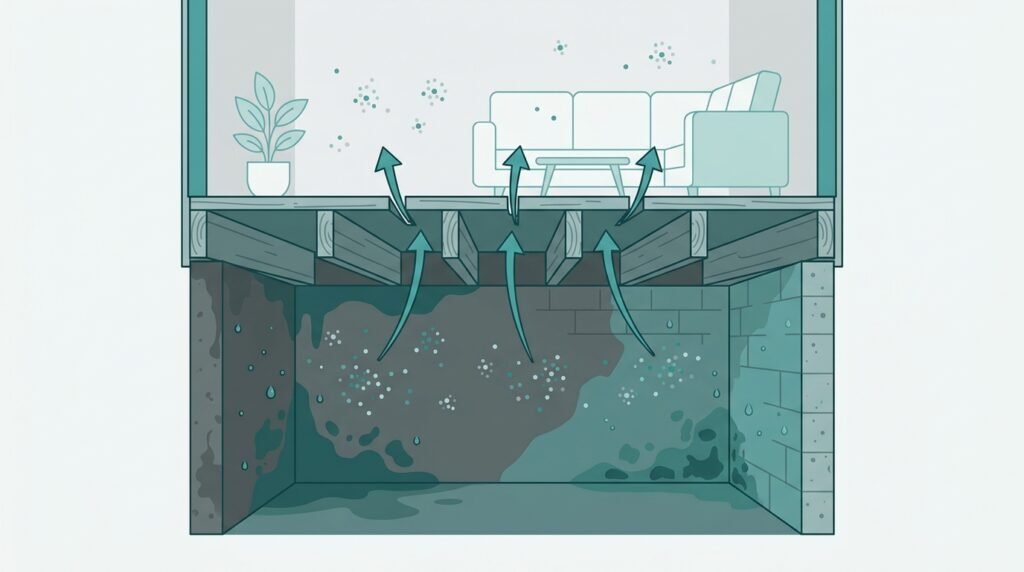
Air does move upward from a basement through the stack effect, so basement air quality is not sealed off from the floors above. That is a reasonable argument for fixing it. It is not evidence that anyone upstairs is being poisoned.
I feel unwell and I have a damp basement. Is it the mould?
It might be, if your symptoms are respiratory or allergic and they improve when you are away from the house. If your symptoms are fatigue, cognitive or mood-related, the evidence does not support attributing those to household mould, and something else may be going untreated while you focus on the basement. See a doctor rather than a remediation company.
Is my baby at risk?
Infants and young children do show elevated rates of lower respiratory illness and bronchitis in damp homes — that part is well supported. The infant pulmonary haemorrhage claim that circulates online traces back to an investigation whose conclusion was subsequently retracted. Fix the damp, and raise any persistent cough or breathing difficulty with your paediatrician.
Should I move out while it is fixed?
For a normal damp basement and a healthy household, no. For someone severely immunocompromised, or during large-scale remediation that will disturb a lot of material, it is a reasonable precaution — ask the person doing the work how much disturbance is involved.