Last Updated on August 25, 2026 by Umar Farooq
A basement that is fine all winter and damp every summer almost certainly does not have a leak. It has cold surfaces and humid air.
Nothing about the building changed in June. What changed is that the air outside started carrying a lot more water, while the basement stayed at roughly the same temperature it always is.
Why the basement is the coldest room, all year
Deep ground temperature barely moves. The Department of Energy puts ground at around 30 feet down at a steady 50 to 59 °F year-round. Your basement is shallower than that, but it is still surrounded by soil that changes temperature slowly and lags months behind the air above it.
So in July, when the air outside is at 85 °F, your basement walls and slab are somewhere in the fifties or low sixties. That gap is the entire problem.
There is a consequence that reframes what you are seeing. Building science field monitoring describes the lower wall and floor slab as actively dehumidifying the interior air in summer, and humidifying it in winter. The slab is behaving like a dehumidifier you did not buy. The water on it is what it pulled out of your air.
The puddle on the floor is not always something arriving. Sometimes it is something leaving the air.
The number that decides everything: dew point
Relative humidity is the wrong measurement for this question, and using it is why the usual advice backfires.
Relative humidity tells you how close air is to saturation at its own temperature. Dew point tells you how much water the air is actually carrying. Only the second one can be compared against a cold surface.
Here is the example that dismantles the folk model, from a building science consultancy measuring their own office:
By bringing in outdoor air at 90% relative humidity, I actually dried out the air in my house.
The outdoor air was 58 °F at 90% relative humidity, giving a dew point of 55 °F. The indoor air was 72 °F at 64% relative humidity, giving a dew point of 59 °F. The air that sounded far wetter was carrying less water.
| Air | Temperature | Relative humidity | Dew point | Actually |
|---|---|---|---|---|
| Outdoor | 58 °F | 90% | 55 °F | Drier |
| Indoor | 72 °F | 64% | 59 °F | Wetter |
So: should you open the windows?
Compare today’s outdoor dew point against the temperature of your coldest basement surface. That is the whole decision.
- Look up the outdoor dew point. Every weather app has it, usually next to the humidity.
- Find your coldest surface temperature. A cold water pipe is a good proxy and runs around 55 to 58 °F.
- Outdoor dew point below that surface temperature — opening up will dry the basement.
- Outdoor dew point above it — opening up deposits water on your walls and floor. Keep them shut.
A useful reference point: 55 °F dew point is what conditioned air at 75 °F and 50% relative humidity works out to. If you do not want to look up dew point at all, outdoor air below about 60 °F is a reasonable rough benchmark for when ventilating helps.
The mild day that catches people out
The commonest reason people open the windows anyway is that it does not feel hot. But temperature is not the variable.
Air at 70 °F and 98% relative humidity is genuinely soaking, and those conditions occur. Building science commentary is direct about it: when temperatures are in the 60s and 70s and outdoor humidity is high, keeping indoor conditions comfortable will probably require a dehumidifier. A pleasant afternoon is not evidence that the air is dry.
Why the fan did not work either
Moving air around does not remove water from it. If the surface is below the dew point of the air touching it, moving more of that air across it condenses more water, not less.
Building science guidance on basements makes the same point about drying generally: it should happen by diffusion rather than by ventilation. A fan is useful for evening out temperature and preventing dead spots. It is not a drying strategy.
The dehumidifier number on the box is not the number you get
This is worth knowing before you buy, and no page recommending a size will tell you.
Dehumidifier capacity used to be measured at 80 °F. The test was changed to 65 °F specifically to reflect performance in a basement, because there is less water to remove from cooler air. The ratings dropped accordingly.
| Old rating (80 °F test) | Same machine, current rating (65 °F test) |
|---|---|
| 30 pints/day | about 20 pints/day |
| 60 pints/day | about 35 pints/day |
And your basement is likely cooler than 65 °F anyway. Below that, frost starts forming on the coil, and the machine spends its time defrosting instead of removing water. Manufacturer guidance is to look for a unit specified for low temperature operation if the space regularly runs below 65 °F.
Aim for 30 to 50% relative humidity. That is the published target and it clears the condensation problem, where a 60% ceiling often does not.
One piece of arithmetic worth doing yourself. A unit genuinely removing 20 pints a day fills a typical 12-pint bucket in well under a day. If nobody empties it, the machine is off for most of the time you think it is working. That is a duty cycle problem, not a preference.
Turning the air conditioning down makes it worse
This is the most common failed experiment, and the reason it fails is specific.
An air conditioner removes moisture only while it is running. Most residential systems are oversized, often by two or three times, so they satisfy the thermostat quickly and shut off before they have wrung much water out of the air.
When the humidity won’t drop, people often lower the thermostat. That often has the result of making the house cool and clammy, not comfortable.
There is a basement-specific twist that makes it worse. Your thermostat is almost certainly upstairs. The basement is already the coolest part of the house, so the system satisfies the upstairs setpoint and stops long before the basement gets any meaningful runtime. The room that needs the most dehumidification receives the least.
Lowering the setpoint also cools basement surfaces further, which lowers the temperature the air has to reach before it condenses. You have made the cold surface colder.
What actually works, in order
- Stop ventilating with humid outdoor air. Free, and often the whole fix.
- Get a hygrometer and check the dew point before opening anything.
- Run a dehumidifier sized honestly, plumbed to a drain, targeting 30 to 50%.
- Insulate the cold surfaces that are condensing, particularly cold water pipes and ducts. Warming a surface above dew point stops condensation on it permanently.
- Deal with any water actually entering, because entry raises the humidity that then condenses everywhere else.
Worth being honest about the last two. A dehumidifier is a running cost forever. Insulation is a one-off. And if the humidity is high because water is getting in, neither of them is the actual repair.
When summer damp is not condensation
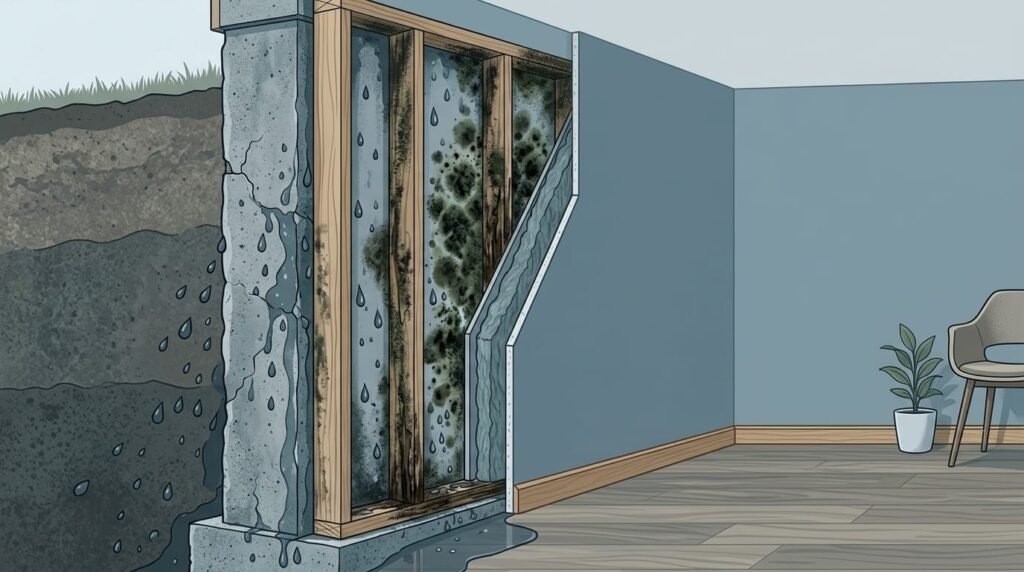
Run the sheet test before you commit to any of this. Tape plastic to the damp area, seal all four edges, wait a day, then look at which face is wet. Room side means condensation and this page applies. Wall side means water is coming through the structure and this page does not.
Other summer-specific causes worth ruling out: a dryer venting into the basement instead of outside, laundry drying indoors, an uncovered sump pit, and heavy watering or new planting against the foundation.
FAQ
When does it become safe to open the windows again?
When the outdoor dew point drops below your basement surface temperature, usually autumn. That crossover is the moment ventilation flips from harmful to helpful, and it is a dew point reading rather than a date.
My hygrometer says 55% in the basement. Is that fine?
Depends what it is at. Relative humidity of 55% at 62 °F is a dew point around 45 °F, which is comfortably below your surfaces. The same 55% at 75 °F is a dew point near 58 °F, which is not. Convert before you conclude anything.
Should I close the basement HVAC vents in summer?
Generally no. Supply air from an air conditioner is drier than basement air, so closing the vents removes one of the few things helping. Closing supplies also unbalances the system.
Why does it smell worse in summer even when the floor is dry?
Warmer material releases odour compounds faster, and higher humidity supports the growth producing them. The smell can intensify without any new water arriving.
Is a fan pointed at the wall useful?
Only after the air is dry. Moving humid air across a cold wall condenses on it. Once the dew point is below the surface temperature, air movement helps things dry evenly.