Last Updated on August 25, 2026 by Umar Farooq
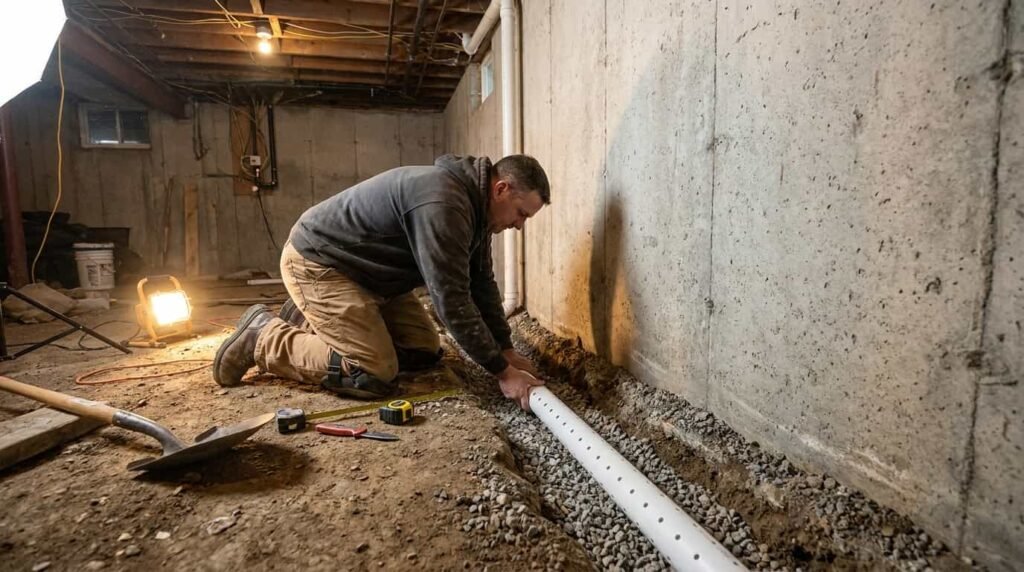
A French drain for a damp basement runs somewhere between about $1,000 and $17,000 depending on what exactly is being installed. We will break that down properly below.
But there is a prior question, and skipping it is how people end up with an expensive trench and a basement that is still damp: does your damp problem involve liquid water arriving from outside at all? A drain collects and redirects water. If your basement is damp from condensation, or from vapour moving up through the slab, there is no water for it to collect.
Check this before you price anything
The test costs nothing and takes a day. Tape a piece of foil or plastic sheet flat against the damp wall, sealed on all four edges, and leave it. National Park Service guidance describes it precisely:
if moisture has developed behind the foil, then it is coming from the masonry. If condensation is on the surface of the foil, then moisture is from the air.
Moisture behind the foil means water is moving through the structure — drainage is potentially relevant. Moisture on the room side means condensation, and a French drain will do nothing for you.
This matters because the top-ranked cost guide for this search lists “increased interior humidity” as a sign that you need a French drain. Building-science research on basement moisture says the opposite: interior humidity is addressed by dehumidification and by controlling condensation, not by a trench outside.
The cheap fixes, priced against the expensive one
Most cost guides for this topic never mention the alternative. Here is the comparison, with every figure from the same source — Delaware’s environmental agency, in 2022 dollars, published for flood-mitigation planning:
| Measure | Cost (2022 USD) |
|---|---|
| Clean the gutters yourself | $0 |
| Downspout elbow + extension (part only, DIY) | $14–$55 |
| Have gutters cleaned professionally | $70–$425 |
| French drain for the yard — DIY materials, 60 linear ft, 8–24 in deep | $600–$2,000 |
| French drain — deep or complex, installed, 60 linear ft | $1,000–$4,000 |
| Regrade the lawn away from the structure (with replanting) | $850–$6,600 |
| Interior drainage system with sump pump — basement | $4,000–$10,000 |
| Exterior drainage system with sump pump — total | $5,600–$17,200 |
That ratio is the whole point of this page. A downspout discharging against the wall is one of the most common causes of a wet basement and one of the cheapest things in the entire building to fix.
Do the free things first — in this order
University extension guidance is unusually direct about sequencing:
The best way to approach any building problem is to first do the things that are easy and low-cost. Then proceed in a logical order doing the next least costly technique with the most positive likely result.
- Control interior moisture sources — unvented dryers, uncovered sumps, drying laundry indoors.
- In summer, stop ventilating with outdoor air. Warm humid air on cool basement surfaces makes things wetter, not drier.
- Fix the gutters, downspouts and grading. The same guidance says these “should be corrected first and may solve the problem.”
- Only then consider an interior or exterior drainage system.
The published specifications are worth having, because they are checkable this afternoon:
- Ground should slope away from the foundation at least 1 inch per foot for at least 6 feet. Building code puts the minimum at a 6-inch fall within the first 10 feet.
- At least one downspout per 50 linear feet of roof eave.
- Extensions should discharge at least 4 feet from the wall — US Department of Energy guidance says at least 5 feet, or 10 feet to an underground catchment.
- Never connect a downspout into the perforated foundation drain. DOE guidance is explicit that this soaks the foundation.
- A downspout without an extension or splash block is worse than no downspout at all — it concentrates the roof’s entire catchment into one spot against the wall.
How much water is at stake. A 1966 National Association of Home Builders study of more than 130 houses with a history of basement leakage, reported by the US Forest Service in 1978, found that 85% of leakage cases occurred after rainstorms. Surface water is the dominant mechanism, and surface water is the cheap fix.
What actually moves the price
Two quotes for the same house can differ by a factor of three because they are pricing different work. These are the variables that matter, and each one is a question worth asking:
| Factor | Why it changes the number |
|---|---|
| Linear feet covered | Full perimeter or one wall. A partial system is cheaper and, in most warranties, only covered in the area serviced — so water arriving at an untreated wall is your problem. |
| Depth to the footing | Exterior work scales with excavation depth. A walk-out basement and a full-depth one are different jobs. |
| Access for machinery | If a digger cannot reach the wall, the excavation is done by hand. This is one of the largest single swings in an exterior quote. |
| What is in the way | Decking, patios, mature planting, driveways, utility runs. Removal and reinstatement is often quoted separately, or not at all until later. |
| Soil type | Clay excavates and disposes differently from sand, and it also changes the iron-ochre and silting risk over the drain’s life. |
| Sump and discharge | Whether a sump pit and pump are included, and how far the discharge has to run to get safely away from the house. |
| Reinstatement | Interior work leaves a channel in your floor slab. Ask whether the concrete is restored, and to what finish. |
| Region and season | Labour rates vary widely, and excavation in frozen or saturated ground costs more. |
Where every published price actually comes from
We went looking for an authoritative, independent cost figure for a residential French drain. There isn’t one. No federal agency, university or public cost database publishes it.
What exists instead is a citation circle. The major cost guides cite each other, and the two ultimate sources are lead-generation platforms — companies paid when you request a contractor quote. That does not make the numbers wrong, but you should know that the benchmark price for this work is produced by businesses whose revenue rises with the size of the job you book.
For the record, the industry consensus band is roughly $40–$100 per linear foot for interior drainage and $10–$90 per linear foot for exterior, with interior systems totalling around $4,000–$17,000. The Delaware figures above sit inside that range and have the advantage of a named public publisher.
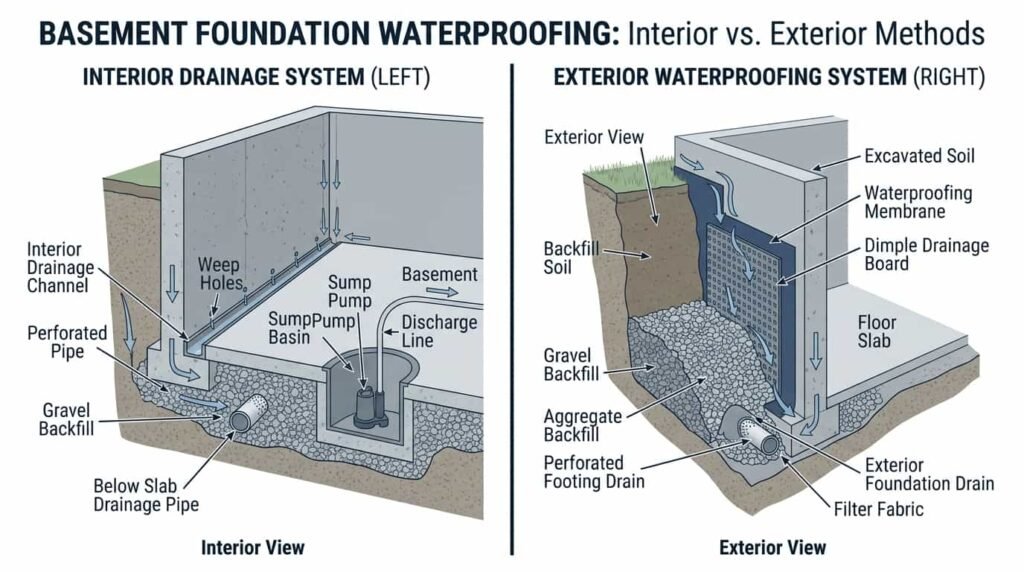
Interior or exterior?
| Interior | Exterior | |
|---|---|---|
| What it does | Collects water that has already entered and routes it to a sump | Intercepts water before it reaches the wall |
| Disruption | Breaking up the basement floor perimeter | Excavating to the footing around the outside |
| Cost | $4,000–$10,000 | $5,600–$17,200 |
| Building science view | Manages the symptom — water still reaches the structure | Preferred where practical — drains groundwater before it reaches the wall |
Worth knowing: building code does not require a foundation drainage system at all where the foundation sits on well-drained ground or sand-gravel soils. Drainage is not automatically necessary just because a basement exists.
What goes wrong with drains later
Nobody quoting you for one will lead with this, and it should factor into the decision.
- Silting. Clean gravel around a drain can move on the order of 22,500 cubic feet of water a day. Once fine soil infiltrates it, that can fall below 100 — a reduction of more than 99%. The same Forest Service study found houses that had perimeter drain tile, parged walls and asphalt coatings and nevertheless leaked.
- Iron ochre. An iron-bacteria sludge that clogs drain pipe, sump pumps and discharge lines. Risk is highest in fine sand, silty sand and organic soils, lowest in clay. Extension guidance treats it as a recognised residential failure mode.
- Filter sock blinding. The permeability of the fabric wrapped around drain pipe can decrease considerably within 2 to 12 years.
- Sump discharge too close to the house. If the outflow lands near the foundation you are simply recycling the same water back through the drainage system.
What a good contractor does before quoting
There is a US state consumer-protection regulation written specifically about this industry. Wisconsin requires that sellers of basement waterproofing services prepare and give the buyer a signed copy of the seller’s analysis of the causes — and the specific processes to correct them — before the contract is signed. The same rule treats ineffective methods and vague guarantees as unfair trade practices.
Whatever your state requires, that is the standard to hold a quote to. If nobody has told you in writing why your basement is damp, a price for fixing it is a guess. Our questions to ask a damp specialist guide covers the rest.
FAQ
Will a French drain stop condensation?
No. Condensation is moisture from the air depositing on cold surfaces. That needs surface temperature or humidity control — run the foil test before spending anything.
Can I install one myself?
A shallow yard drain, 8 to 24 inches deep, is a realistic DIY project — Delaware prices the materials for 60 linear feet at $600–$2,000. Interior perimeter drainage means breaking up your floor slab, and exterior means excavating to the footing. Those are not DIY jobs.
Will a yard French drain fix a wet basement?
Sometimes, if surface water is the problem. But the same government guidance notes that simple French drains route standing water away from the foundation and may not be effective at preventing seepage into the basement or crawlspace. Manage your expectations accordingly.
How long does a French drain last?
Design life is commonly quoted around 25 years, but the failure modes above — silting, iron ochre, sock blinding — can shorten that considerably depending on your soil. Ask specifically about clean-out access.
Is a dehumidifier a cheaper alternative?
For a condensation problem it is the right tool, and a portable unit runs around $315 installed with first-year running costs near $112, against roughly $2,733 for a ducted whole-home system. For a water-entry problem it manages symptoms only, and extension guidance warns that in a basement with unresolved moisture problems it may cause greater damage rather than less.