Last Updated on August 25, 2026 by Umar Farooq
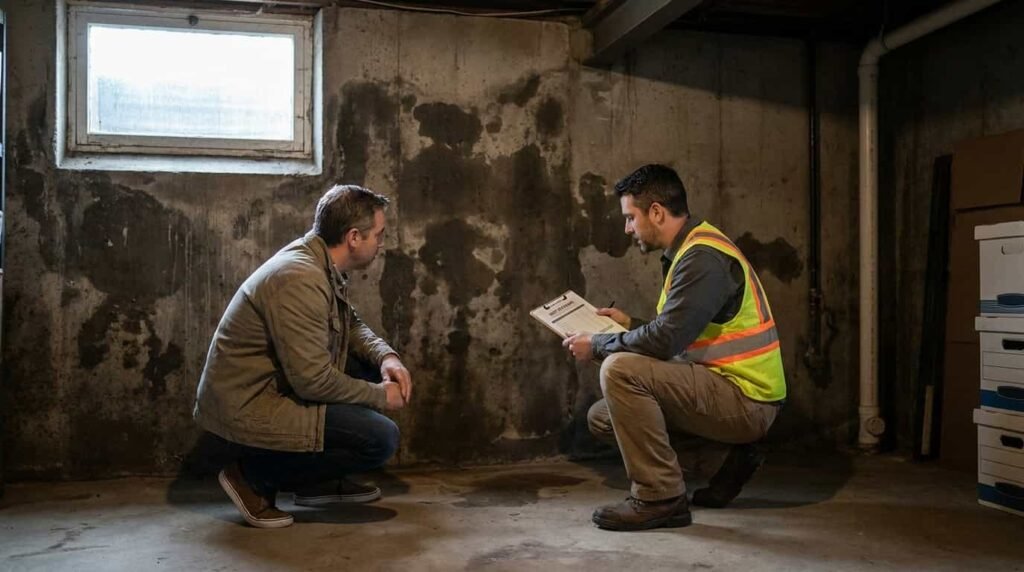
Somebody is coming to look at your damp. There is a reasonable chance they work for the company that will sell you the cure, and one firm advertises the arrangement plainly, noting that the survey fee is deducted from the cost of works if you go ahead.
That is not automatically dishonest. It does mean the survey and the sale are the same visit, and you should be able to tell a diagnosis from a pitch.
Every page listing questions to ask stops at the questions. That does not help, because you cannot score an answer you do not know the shape of. So each question below comes with what a good answer sounds like, what a bad one sounds like, and where the standard comes from.
First, the sentence that reframes the whole visit
From the surveying institution, not from a contractor:
So “you have rising damp” is not a diagnosis. The same source says it outright: rising damp is not a conclusion, as it does not identify the source of the excess moisture.
If the visit ends with a mechanism and a product but no source, it has not finished.
The single most useful thing you can ask for
There is a standard for this, published in 2022 by the surveying institution together with the national heritage body and the damp-proofing industry’s own trade association. And the institution tells consumers to ask for it by name:
Ask that on the phone before anyone visits. It is a short sentence and it changes the conversation, because the standard itself contains a checklist you can hold them to.
The standard does not pretend the conflict does not exist. It addresses it directly, saying that where a contractor is quoting rather than only reporting, impartiality means reporting objectively on the facts and only suggesting works proportionate to the defects found. And it requires this:
The questions
1. “How did you rule out condensation?”
Ask this first, because it is the commonest misdiagnosis and because the industry admits it. From the trade body’s own guidance:
| A good answer | A bad answer |
|---|---|
| They took air temperature, relative humidity and surface temperature, and compared the wall surface against the dew point. They mention monitoring over time rather than one visit | “It’s not condensation, there’s no mould on the windows.” Or a single humidity reading. Or no surface thermometer in the bag at all |
In a basement this is the highest-risk error, because the walls are cold, the ventilation is poor and there is often a tumble dryer down there. Anyone who does not take a surface temperature in a basement has not ruled condensation out.
2. “That reading says 22%. Twenty-two percent of what?”
This is the question that changes the room, and it has three independent sources behind it including the meter manufacturer.
The surveying institution warns consumers directly:
The trade body’s own guidance concedes the same, and more:
It adds that the electrical method does not give a direct reading of moisture content, that its value depends on the ability of the user to interpret it, and that it can give rise to confusion and incorrect diagnosis, particularly where ground salts are present or where the dampness is due to condensation.
And the manufacturer explains what the number on the screen actually is. Wood is the base scale that other materials are measured in reference to, and the system is called Wood Moisture Equivalent.
So the number he is showing you on a brick wall is a wood number. That is not a scandal, it is how the instrument works, and a competent surveyor will say so without hesitation.
| A good answer | A bad answer |
|---|---|
| “It’s a relative scale, wood referenced. I’m using it to map the pattern of moisture, not to measure the wall. I’ll confirm with a sample.” | Quoting the percentage as though it is the wall’s moisture content. Or getting annoyed at the question |
The meter cannot even test a damp course
Worth keeping in your back pocket, because it is the trade body’s own sentence:
Which means a diagnosis of “your damp course has failed”, reached with a meter, is unsupported by the industry’s own method guidance.
3. “Did you take any samples?”
The trade body lists three methods of determining moisture in masonry: gravimetric oven drying, the chemical carbide method, and electrical. It describes the first as by far the most accurate available and the one that can distinguish between ground moisture and hygroscopic moisture. The carbide method is quicker, works on site, and takes three to five minutes per sample.
On when sampling becomes necessary rather than optional:
Nobody says sampling is always required, and we are not going to claim otherwise. The honest line is this: if somebody is recommending four figures of irreversible work on meter readings alone, they have skipped the only method that could have separated the causes, and their own trade body says the meter cannot separate them.
4. “Did you test for hygroscopic salts?”
This is the question that separates a diagnostician from a salesperson, because salts produce the exact symptom with no active water at all.
There is a real test with a published threshold. Dried samples are conditioned at 75% relative humidity until they reach constant weight, giving a hygroscopic moisture content, and a figure greater than 2% suggests high salt contamination.
| A good answer | A bad answer |
|---|---|
| “I’ve drilled samples. They’ll be conditioned at 75% RH to separate the hygroscopic fraction from free water.” | A blank look. Or “the salts are the rising damp” |
5. “Did you go outside?”
Startlingly often, the answer is no. The trade body makes it mandatory in its own guidance:
A surveyor who never left the building has failed a test set by the damp industry itself.
The published external checklist is long and specific: leaking or blocked gutters and rainwater pipes, ill-fitting doors and windows, roofing defects, open chimney pots, poor external pointing, cracked render, raised ground levels next to walls, excess rubble under suspended floors, failed underground drainage, leaking water mains, bridged cavity walls, blocked low-level vents, broken sealant around openings, internal plumbing leaks, flooding and a high local water table.
On ground levels, the relevant figures differ by country. UK guidance for new work puts the damp proof course at least 150 mm above ground level. US code requires the grade to fall not fewer than 6 inches within the first 10 feet, and impervious surfaces within 10 feet to slope at least 2 percent away.
6. “Which of the other sources have you ruled out?”
The joint standard expects a thorough inspection covering possible sources of moisture including above-ground and below-ground water supply services, and understanding of typical sources across external, internal, ground, building services and drains.
So: the roof, the plumbing, the drains, the water main. If none of those were looked at, the list of candidates was never narrowed, it was just skipped.
7. “What happens if this does not work?”
The standard prescribes an approach that is incompatible with a single irreversible treatment proposed on day one:
A good answer describes that sequence. A bad answer is “it’ll work”.
8. For a basement: “Is this even rising damp?”
This is the question specific to a below-ground room, and it is the one most likely to be answered wrongly.
A basement wall is earth-retaining. The trade body describes the mechanism precisely:
And it adds that where the water table is high, lateral penetration may be aggravated by hydrostatic pressure.
That is a different physical problem from rising damp, and it has a different governing standard. Below-ground structures fall under the code of practice for protection of below ground structures against water ingress, which deals with evaluating groundwater conditions and managing those risks. We have covered separately why the code of practice for chemical damp-proof courses explicitly excludes walls below ground level and walls under hydrostatic pressure.
So if someone stands in your basement, diagnoses rising damp and proposes injecting a chemical damp course, they have applied the wrong physics and the wrong standard. Ask which standard they are working to.
What the report has to contain
Here is the checklist, and it is the most useful part of this page, because you can hold a report against it without knowing anything technical. The joint standard specifies that a report should include:
- A summary of observations, including an assessment of significance.
- The importance of regular building maintenance, especially roofs, gutters, hidden gutters, rainwater disposal and changes in external ground levels.
- An impartial diagnosis, clearly explained and laid out systematically.
- Where remedial works are recommended, solutions clearly explained and prioritised.
- Alternative options, each with advantages, disadvantages, and cost and time implications.
- Where monitoring and staged interventions are appropriate, the reasons for them and their cost and time implications.
- Where appropriate, whether the building represents a financial risk to a buyer or lender.
- Any conflicts of interest.
Look at item five. A report that offers one solution, with no alternatives and no comparison, fails on its face. You do not need to understand damp to check that, and it is the single most common failure in this market.
Red flags in the diagnosis itself
| What happened | Why it is a problem |
|---|---|
| The whole thing took ten minutes with one meter | A meter maps a pattern. It does not identify a source |
| A percentage was quoted as the wall’s moisture content | The trade body says the electric method does not provide a percentage reading of moisture content on walls of uncertain composition |
| “Rising damp” was the conclusion | The surveying institution says that is not a conclusion, because it does not identify the source |
| Rising damp diagnosed high up the wall | The trade body describes rising damp above five feet as unusual, and only where evaporation is being blocked |
| They never went outside | Mandatory in the trade body’s own guidance |
| Condensation was never mentioned | The commonest misinterpretation, per the same guidance |
| One treatment proposed, no alternatives, no monitoring stage | Fails items five and six of the report specification |
| A quote was produced on the spot | Incompatible with fixing obvious defects, monitoring, then reassessing |
| Rising damp diagnosed in a below-ground room | Wrong mechanism and wrong standard. That wall is earth-retaining |
If the answers were bad
You are not stuck with it, and the advice comes from a heritage charity rather than from us:
The typo is theirs. The point stands. Ask for it to be redone against the standard, or commission an independent survey from somebody who does not sell remediation. The surveying institution suggests looking for a building surveyor with experience in building pathology, which it describes as the specialism focused on the science of the causes and effects of how buildings fail.
On qualifications, be a little sceptical. The main damp-industry certificate is a vocational, non-degree qualification in remedial treatments, reached through a Level 3 short course. It certifies familiarity with the products. That is not the same as a building pathology qualification, and a chartered surveyor who holds it has argued publicly that a standalone course in damp diagnosis is still needed.
None of that makes a certificated surveyor incompetent. It does mean the certificate is not the answer to “how do I know this diagnosis is right”. The answers above are.
A word for older buildings
If your house is old, one more principle is worth carrying into the conversation:
The joint standard says the same in its own terms, requiring a holistic diagnosis that identifies and deals with causes rather than focusing on symptoms, and proportionality between any recommended works and both the defect and the significance of the building.
FAQ
Should I pay for an independent survey?
If the free one produced a single product recommendation with no alternatives, yes. The surveying institution’s whole point about a compliant inspection is that it gives you an opinion from someone with no commercial interest in selling you a product.
The surveyor showed me a high reading. Is that proof?
Of a reading, not of a cause. Salts, foil-backed paper, carbon in the substrate and condensation all raise readings. The meter tells you where to investigate, not what you have.
They said my damp course has failed. How do I check?
Not with a meter, per the trade body’s own guidance, because salts produce high readings whether or not the course is working. Ask what sampling was done and how ground moisture was separated from hygroscopic moisture.
Is a free survey always a bad survey?
No, and we are not going to claim that. The standard explicitly contemplates a contractor who quotes as well as reports, and asks for objectivity, proportionality and a declared conflict of interest. Judge the report against the eight items above rather than judging the price of the visit.
What if they get annoyed at these questions?
That is itself information. Every question here comes from the surveying institution, the joint standard, or the damp industry’s own published guidance. A competent surveyor will recognise them.
My basement is below ground. Does any of this change?
The condensation, measurement and salts questions all still apply. What changes is question eight: the wall is earth-retaining, so lateral penetration and hydrostatic pressure are the likely mechanisms, and the governing standard is the one for below-ground structures rather than the one for chemical damp courses.