Last Updated on August 25, 2026 by Umar Farooq
Somewhere between four and seventeen thousand dollars. That is the honest range you will find published, and it is close to useless, because three quite different systems are sold under the same name at overlapping prices.
Before any of the numbers matter, there is a measurement worth taking.
Measure your slab first
The leading engineered interior channel has a third-party engineering evaluation behind it, and that report sets a condition nobody quotes you.
In basements and other subterranean structures with a minimum 3½” thick concrete slab.
Now the other half. Basement floors are typically two to four inches thick and typically have no structural role in the foundation.
Read those together. A meaningful share of older basement slabs are thinner than the minimum at which the leading engineered system is approved. The report also specifies concrete cover over the channel, a minimum of an inch and a half on one version and two inches on the other, and requires that the code minimum three and a half inch slab still applies outside the gravel area.
Drill a small test hole in an inconspicuous corner, or ask the estimator to, before you sign anything. If your slab is three inches, the conversation changes.
Three systems, one name, very different work
This is why the quotes you are comparing are not comparable.
| System | What actually happens | What it cannot do |
|---|---|---|
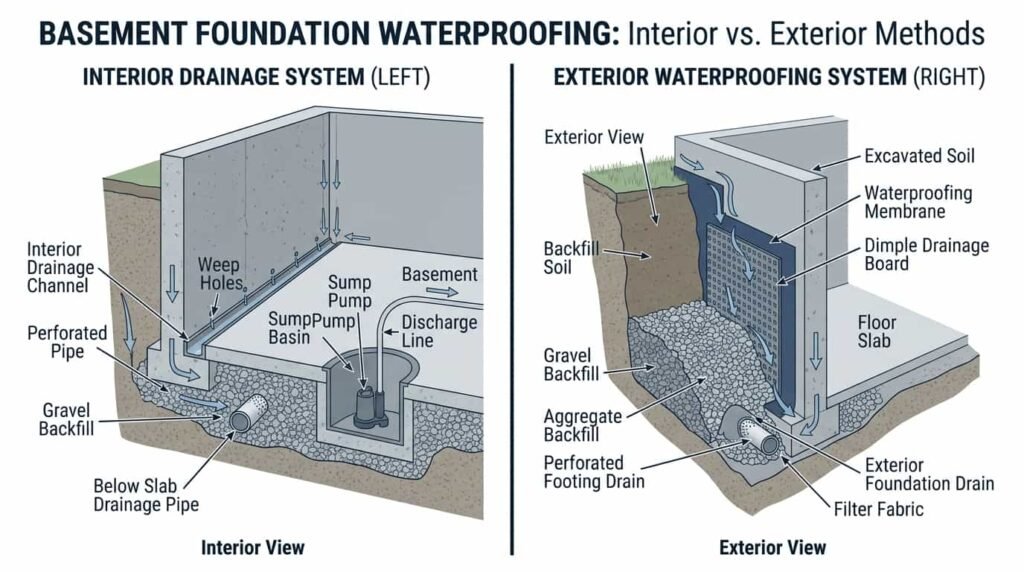
| Channel glued on top of the slab | A plastic moulding bonded over the wall-floor seam, draining to a sump. No concrete is cut. Least disruptive and cheapest | Cannot drain groundwater from under the floor slab. The water stays under there, so humidity and mould remain. On block walls it leaves water sitting in the cores |
| Channel cut into the slab edge, sitting on the footing | The slab perimeter is cut out and a channel formed on top of the footing | Works on block walls only if holes are drilled at the base of every block core. Ask whether that is in the price |
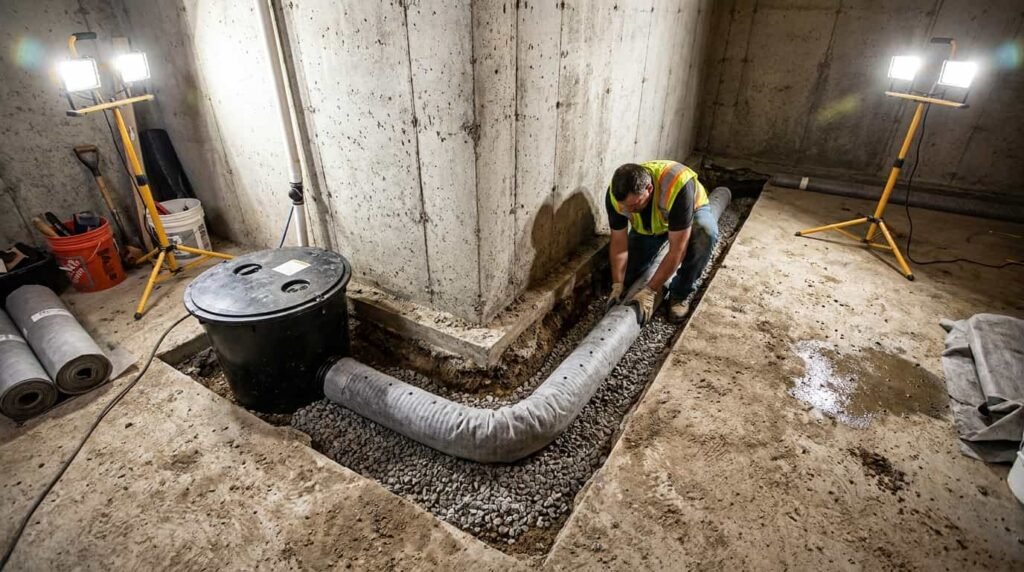
| Perforated pipe below the slab, inside the footing | Slab cut, pipe bedded in aggregate below floor level | The most effective interior option because it drains lower than the floor. In low permeability soil it cannot accept rising groundwater without an aggregate layer under the slab |
Worth knowing: the engineering evaluation located covers the below-slab engineered channel. No equivalent third-party report was found for the above-slab baseboard type, which is not proof that none exists, but it is a reasonable thing to ask a salesperson for.
The numbers, and where they come from
An honest caveat first, because no page in this market gives one. Every per-linear-foot figure below traces back to contractor self-reporting or to two lead-generation marketplaces that aggregate it. Nobody has run a primary survey. Treat these as the going rate rather than as data.
| Source | Per linear foot | Typical total |
|---|---|---|
| HomeGuide | $40 to $85 | $4,000 to $12,000 |
| This Old House, sourcing Homewyse and Angi | $60 to $120 interior drainage; $25 to $55 subfloor drain tile | — |
| A Michigan contractor publishing line items | $55 to $80 fully installed | $12,200 on its worked example |
| A Maryland contractor | $60 to $100 | $4,000 to $10,000 |
| A multi-branch Chicago contractor | Publishes no per-foot figure at all | $8,000 to $15,000 |
| A Denver contractor | — | $4,000 to $17,000 |
The components, priced separately
| Item | Cost |
|---|---|
| Perimeter drain, the labour and channel itself | $9,200 on the one published worked example |
| New sump pit and pump where none exists | $1,200 to $2,500. The pit alone adds $500 to $1,000 |
| Pump swap in an existing pit | $650 to $1,200 |
| Battery backup | $1,200 to $1,800 installed by a waterproofer. $300 to $800 if you buy and fit the unit. Batteries then need replacing every three to five years |
| Sealed radon-ready basin upgrade | About $400 |
| Weep holes through block cores | About $5 per hole, typically 20 to 30 holes |
| Discharge routing | $100 to $300 simple, $300 to $800 complex |
What is not in the quote
This is the section that saves people money, because these costs arrive after the contract is signed.
Putting your basement back
One contractor states it plainly on its own site, which is more than most do. Reputable quotes do not include reinstallation of finished basement materials that had to come out, drywall, panelling and carpet pad among them. They put the basement back to bare. Restoration is a separate trade and should be quoted by a finish carpenter or general contractor.
The concrete strip itself does get replaced. Its appearance may not be guaranteed: cosmetic concrete concerns and natural cracking appear on published exclusion lists. For scale, the demolition strip is roughly six to eight inches out from the wall, so you can sanity check any concrete line item against replacement floor rates of six to eleven dollars a square foot with demolition adding two to four.
The electrical
It appears in no cost breakdown reviewed, and it is required. Since the 2020 code all basement receptacles need GFCI protection, finished and unfinished, and there is no exception for sump pumps. Budget $130 to $300 to swap a receptacle, or $570 to $1,000 if a dedicated circuit has to be run.
Moving your own belongings, twice
Contractors ask you to clear furniture and stored items away from the walls before installation, which is reasonable. The clause worth reading is the one in the warranty:
That is not the install. That is every warranty callback for the next twenty years.
The permit and the discharge
The engineering report requires that it and the installation instructions be submitted at the time of permit application, so a permit is contemplated by the system itself. Only one page in this entire market lists a permit line.
And the discharge has to go somewhere legal and far enough away. Depositing the outflow next to the foundation simply recycles water in and out through the drainage system. Discharge to the sanitary sewer is prohibited by ordinance in many municipalities.
The dehumidifier
Never included. The engineered channel even has an inspection port designed to accept a dehumidifier or condensate line, so the system anticipates equipment the quote does not buy you.
The warranty clause worth finding
Lifetime transferable warranties are the industry’s main selling point. One company publishes its actual terms, and the fine print is the story.
Perimeter System (Four Walls): Contractor will repair cove and floor seepage. Partial System: (Less than Four Walls): Contractor will repair cove seepage only in the area serviced. Warranty is transferable at no charge to a new homeowner. Sump pumps and high water alarms shall carry a one year warranty.
A lifetime warranty on the channel, and one year on the pump. The pump is the only moving part, and the part that fails. Another company’s exclusion list names clogged discharge lines from lack of maintenance and power outage failures on standalone pumps, which between them cover most of the ways a wet basement actually happens after installation.
Two more to check. Partial systems warrant only the walls in the contract, so if water later appears on an untreated wall you are outside it. And “lifetime” is sometimes defined as for as long as you own the home, which sits oddly beside the transferability being advertised. Ask for the written terms before the deposit, not after. Some firms advertise lifetime transferable cover and publish no terms on the page at all.
There is one more structural risk nobody mentions. The engineering report specifies that the system be installed exclusively by that manufacturer’s dealers. If your dealer leaves the network or closes, both the warranty and the proprietary channel are orphaned.
Before you spend a penny of this
Interior drainage collects free water arriving under or beside your slab. If that is not what is happening, it is the wrong purchase, and there are three common cases.
| What you actually have | Why a drain does nothing |
|---|---|
| Condensation. Warm moist air meeting basement surfaces below the dew point of that air | The water forms on the wall face. There is nothing under the slab to collect |
| Capillary rise. Moisture drawn up through the footing and slab | There is no free water to intercept. The fix is a capillary break, which is a different job |
| Entry above the slab. Seepage at the sill plate, or through a window well | Water entering above floor level is above the drain and will never reach it. Negative grade or a well drain is the answer |
And the arithmetic that should come first
One inch of rain produces 623 gallons of runoff for every 1,000 square feet of impervious surface. A downspout dumping that beside your foundation is what most hydrostatic pressure quotes are really selling against.
A downspout elbow and extension costs somewhere between fourteen and fifty-five dollars. Do that, fix the grading, and watch through a wet season before you spend eight thousand on drainage. It is the cheapest experiment available and it settles the question.
Things you may be told that are wrong
- “We’ll just seal the floor crack.” Sealing floor cracks to solve a seepage problem is not usually recommended, because it allows the water pressure to build and move elsewhere. The same guidance says epoxy or urethane injection at that location does little more than create a damming effect.
- “Waterproof coating is a cheaper alternative.” These products are expected to prevent damp conditions rather than stop active water intrusion, and the water is still there, and eventually these systems deteriorate or simply move the water to another pathway into the basement.
- “An open sump pit is fine.” Uncovered or improperly sealed sump pumps allow radon and other soil gases into the basement. Recent code editions require a gas-tight removable cover. Insist on a gasketed, mechanically attached lid.
- “Interior drain tile requires no maintenance.” This appears verbatim in industry guidance and is contradicted by the warranties, which exclude clogged discharge lines from lack of maintenance.
- “A dehumidifier will handle it.” Not on a basement with a moisture problem. Drying the air draws moisture in more rapidly, causing efflorescence and spalling of the concrete.
What a comparable quote has to specify
Hand this list to every estimator. Two quotes that answer all ten can be compared. Two that do not, cannot.
- Linear feet, and which walls. Full perimeter or partial, because the warranty scope follows this.
- Which of the three systems it is, in plain language.
- Measured slab thickness, and whether it meets the system’s minimum.
- Concrete cover depth over the channel on reinstatement.
- Gravel specification. The engineering report calls for minimum half inch crushed stone, with the side facing the footing left free of stone so an air space exists between footing and channel.
- Vapour retarder laid over the channel and gravel before the concrete goes back. Frequently absent from quotes.
- Weep holes in every block core, if you have block walls, and how many.
- Sump lid, sealed and gasketed, and whether the pit is new.
- Discharge destination and distance from the house.
- Who supplies the electrical, and the permit.
One safety item to raise as well. The report warns not to undermine the footing or cause damage that would compromise its structural integrity, and that care must be taken so the load resisting capacity of the wall is not compromised. Ask how they avoid that on your foundation.
FAQ
Why is my quote per linear foot rather than by area?
Because the work follows the perimeter, not the floor. A larger basement with the same wall length costs roughly the same. It also means a partial system is priced proportionally, and warranted proportionally.
Is interior cheaper than exterior?
Usually, and it does a different job. Interior drainage manages water that has already reached the foundation. Exterior work stops it arriving. The cheap outside items, gutters, extensions and grading, should always be tried first.
Will they break my whole floor?
Only a strip roughly six to eight inches wide around the perimeter, for the two systems that cut concrete. The top-of-slab channel cuts nothing. Use that width to check the concrete line on your quote.
Do I need a battery backup?
If the reason your basement floods is a storm, and storms take the power out, then a pump on mains alone is a system with a known single point of failure. Note that power outage failures on standalone pumps are a named warranty exclusion.
The system was installed and it is still humid down here. Is that a fault?
Not necessarily, and it depends which tier you bought. A top-of-slab channel leaves the groundwater under the floor, so humidity and mould can continue. The dehumidifier is a separate purchase that the system design assumes you will make.