Last Updated on August 24, 2026 by Umar Farooq
Before any number is useful, one thing about this topic is worth knowing: on the first page of results for basement mould remediation cost, there is no independent source. Every result is either a remediation company or a marketplace that gets paid when you request a quote.
That matters because of where the figures come from.
Every price you will read traces back to two companies
The numbers repeat across the whole category — roughly $10–$25 per square foot, a national average around $2,300, basements at $500–$3,000. Follow the attributions and they converge on Angi and HomeAdvisor member-reported data.
Those are lead-generation businesses. They are paid when a homeowner asks to be connected with a contractor. That does not make the figures fabricated, but it does mean the industry’s benchmark pricing is self-reported by the people selling the work and published by companies whose revenue depends on you booking it. There is no independent measurement anywhere in this market.
Treat every published remediation price, including the ones repeated below, as an asking price rather than a value.
The figures being quoted, and what they leave out
With that caveat attached, here is what the market is publishing, so you have something to measure a quote against:
| Job | Commonly quoted range |
|---|---|
| Basement mould remediation | $500–$3,000 |
| National average, all jobs | around $2,300 |
| Per square foot | $10–$25 |
| Small patch, under 50 sq ft | $500–$1,500 |
| 100 sq ft | $1,000–$2,500 |
| 500 sq ft | $5,000–$12,500 |
| Whole house | $10,000–$30,000 |
| Mould inspection / air sampling | $300–$1,000 |
The omission is the point. A quote of $1,800 to remediate and $0 to fix the moisture is not an $1,800 job. It is $1,800 every time the wall gets wet again.
The 10 square foot line changes what your job needs
This is the most useful thing on this page, and no ranking competitor draws the conclusion. EPA guidance scales the required precautions to the size of the affected area:
| Affected area | What EPA guidance specifies |
|---|---|
| Under about 10 sq ft (roughly 3 ft × 3 ft) | Minimum PPE — gloves, N-95, goggles. No containment. No negative air. In most cases a homeowner can handle the job. |
| 10–100 sq ft | Limited containment — a single layer of 6-mil poly sheeting, half- or full-face respirator with P100, disposable coveralls. |
| Over 100 sq ft | Full containment — double poly layers with a decontamination airlock, full-face PAPR with P100, full body suit, respirator training. |
So the first question to ask about a quote is not the price. It is: how many square feet of mould are you pricing, and does the scope of work match what guidance specifies for that size? A $2,300 quote with full containment on a 6 square foot patch behind a washing machine is not a bargain or a rip-off — it is the wrong job.
The question that decides whether any of it is worth paying
Remediation removes what has grown. It does not stop it growing again, and on this the EPA is repetitive to the point of bluntness:
No matter how good the mold cleanup is, if the water problem is not solved, mold will return.
There is a second EPA statement that reframes the entire purchase. Remediation is not aiming for a spore-free room, because sterilising a building is described as not possible or desirable — a background level of spores remains, and those spores simply will not grow once the moisture problem has been resolved.
Read that carefully. The deliverable is a dry basement, not a clean one. Which means a remediation quote that does not include diagnosing and fixing the moisture source is not priced for the outcome you want. It is priced for a result that expires.
Before accepting any remediation quote, get the moisture answer. Run the sheet test, work out whether you are dealing with condensation or water entry, and price that repair alongside the remediation. Very often the moisture fix is the cheaper half and the only one that ends the problem.
Cost by cause, not by square foot
Every competing page gives basements a single flat range. That is close to useless, because the cause is what determines whether you pay once or repeatedly.
| What is causing the damp | What that means for the money |
|---|---|
| Condensation on cold surfaces | Often the cheapest to resolve — humidity control and surface temperature, no excavation. Remediate after the humidity is under control, or you will be paying for it twice. |
| Surface water — gutters, downpipes, ground slope | Frequently fixable for a few hundred at most, sometimes for nothing but an afternoon. Fix first, then remediate. |
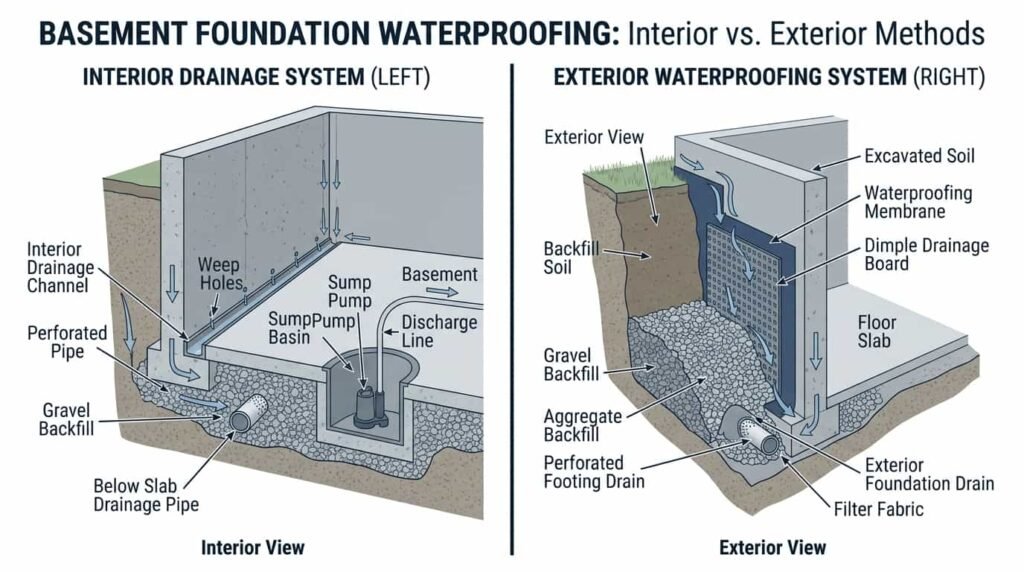
| Hydrostatic seepage through the structure | The expensive category. Drainage work can run into five figures, and remediation before that work is complete is money burned. |
| A plumbing leak | Cheap to fix once found, and the one category where insurance may actually pay. |
| Slab with no vapour barrier beneath it | Continuous, will not finish drying, and remediation alone will recur indefinitely. |
Testing is usually a line item you can decline
Mould inspection and air sampling commonly runs a few hundred dollars and is offered as a sensible first step. On a damp basement where you can already see or smell the problem, it usually buys nothing.
EPA guidance states that in most cases, if visible mold growth is present, sampling is unnecessary, and that there are no federal standards for airborne mould to compare a result against. New York State’s health department goes further, saying that mould testing is not recommended and is not required by any regulatory agency, and that sampling can cost more than simply cleaning and fixing the water problem.
The same guidance disposes of species-based pricing. Knowing which mould you have does not change what you should do about it — so a quote that costs more because somebody called it black mould is charging you for a distinction the health agencies say is irrelevant.
A conflict of interest serious enough that one state banned it
The standard offer in this industry is a free inspection from the company that will then quote for the work. It is worth knowing how seriously that arrangement is taken elsewhere: New York State law prohibits the same licensed worker from carrying out both the assessment and the remediation on a property, explicitly to protect against fraud.
Whatever your state requires, the principle is portable. The person who tells you how much mould you have should not be the person paid according to how much mould you have. If your assessment and your quote come from the same clipboard, get a second opinion before signing.
Insurance: a damp basement is usually the uncovered category
Homeowners policies generally distinguish sudden and accidental damage from gradual damage caused by lack of maintenance. Industry guidance lists damage due to lack of maintenance and mould among the things a policy will not cover.
Chronic basement damp — seepage, condensation, a slow leak that has been running for months — lands squarely in the uncovered category. A burst pipe last Tuesday is a different conversation and may well be covered. Where mould cover does exist it is often a sublimit or a paid rider rather than full coverage, so read the specific endorsement rather than assuming.
Red flags in a remediation quote
- No moisture diagnosis in the scope of work. If the quote does not say what is wetting the wall, it cannot promise the mould will not return.
- Air testing sold before cleanup when the mould is already visible.
- Species-based pricing or a premium because it is “black mould”.
- Full containment specified for a small patch. Match the scope to the affected area.
- The assessor and the remediator are the same company, with no independent verification offered.
- No square footage stated. Everything above depends on that number, so it should be in writing.
- Clearance testing by the same firm that did the work — industry standards call for that verification to be independent.
How to know it actually worked
EPA’s own checklist for a successful cleanup contains no laboratory test at all. It is:
- The water or moisture problem has been completely fixed.
- No visible mould, mould-damaged materials, or mouldy odours remain.
- Spore levels indoors are similar to outdoors.
- A return visit shows no water damage and no regrowth.
- People can occupy the space without health complaints or physical symptoms.
Four of those five you can check yourself, for nothing, over the following months. Judge it across a full humid season rather than the week after the van leaves.
FAQ
Can I just do it myself?
Under about 10 square feet, EPA guidance says most people can. Above that, or if anyone in the house has asthma, a respiratory condition or is immunocompromised, bring somebody in. And either way, the moisture source has to be dealt with or you will be doing it again.
Why are the quotes I am getting so different?
Usually because they are pricing different scopes — different square footage, different containment levels, some including moisture repair and some not. Ask each for square footage and containment level in writing and the quotes usually become comparable.
Is bleach a cheap alternative?
EPA does not recommend biocides such as chlorine bleach as a routine practice, partly because dead mould still causes reactions and still has to be removed. There is a practical exception worth knowing: New York’s health department notes that where it is impractical to eliminate the moisture source, diluted bleach can keep growth under control — while adding that in areas that can be kept dry, bleach may not be necessary at all, because mould cannot grow without moisture.
Should I pay for clearance testing after the work?
It is permitted rather than prescribed — surface sampling can help confirm an area was adequately cleaned. If you do commission it, use someone independent of the firm that did the remediation.
Is remediation worth it at all?
If the moisture problem is fixed, yes — damp indoor environments have a well-documented association with respiratory symptoms and asthma. If the moisture problem is not fixed, you are buying a delay, and the honest answer is to spend that money on the water first.