Last Updated on August 25, 2026 by Umar Farooq
Short answer: no, and the colour was never the thing to look at. The longer answer is more useful than reassurance, because the species growing on a basement wall tells you something real. It just does not tell you what people think it does.
First, a word about where you have probably been reading.
Why the search results contradict each other
On the four commonest searches for this, nearly every result is published by a company that gets paid when you decide you have a dangerous problem. Remediation contractors, waterproofing firms and testing laboratories. Several rank with zero citations of any kind while making specific health claims.
The non-commercial results are a hospital, two state health departments and the environmental regulator. Those say something noticeably different from the pages around them.
This site sells nothing. Everything below links to a public health body, a professional medical college or the peer-reviewed literature, and where the sources disagree we say so rather than picking the scarier one.
Colour identifies neither species nor hazard
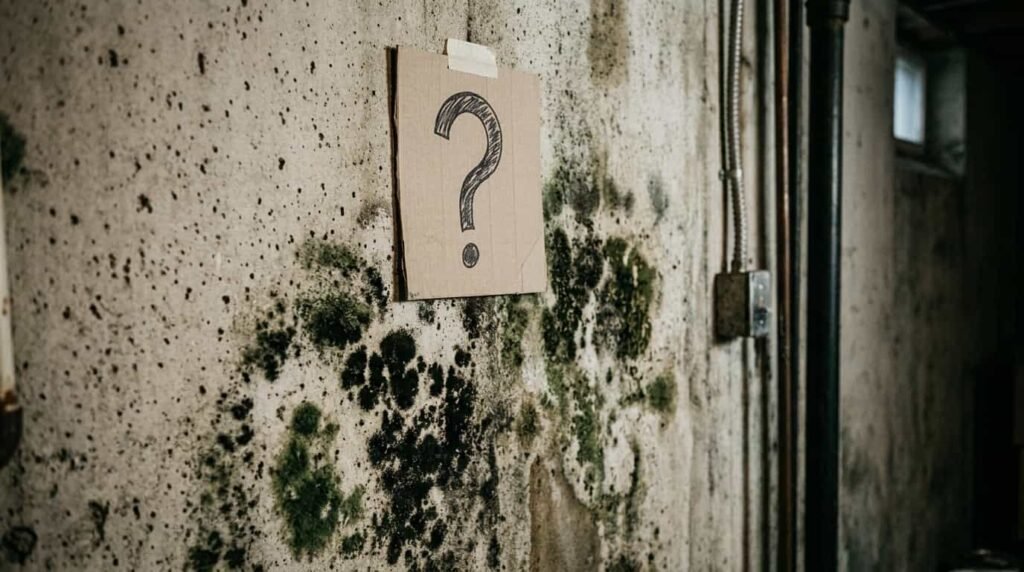
Many moulds are black. The one people mean, Stachybotrys chartarum, cannot be identified by eye, and it does not even look the same as itself: it appears black, shiny and slimy while it is actively growing and powdery or sooty once dry. Two different looking patches can be the same organism at different moisture levels.
A state health department puts the practical consequence in one sentence:
It doesn’t matter if it is black, red or green, any mold indoors is a problem.
That is not a scare. It is the opposite. It means you do not need to identify anything to know what to do.
The toxic mould question, answered properly
There is a formal position statement on exactly this, published in August 2025 by the American College of Medical Toxicology. It is thirteen months old and appears on none of the pages competing for this search.
Its central distinction is one almost nobody makes:
A mould that can produce a toxin is not the same as a toxin being present. The allergy literature made the same point nearly two decades earlier, noting that the mere presence of such a mould should not be taken as evidence that the mould was producing any mycotoxin.
Then there is the dose question, which is where the popular story falls down:
And on the specific fear that drives most of these searches, the neurological one:
A 2006 position paper from the allergy and immunology side reached a compatible conclusion in its own words, that mould-related toxicity from inhaled mycotoxins in non-occupational settings is not supported by the current data and its occurrence is improbable. That paper is old enough that its publisher no longer treats it as current policy, which is why we lean on the 2025 statement. It is worth knowing the two agree.
The wording the authorities actually use
We are not going to overstate this in the other direction either. The toxicologists do not say “disproved”. They say:
Cast doubt on. That is the honest register, and it is what a careful reader should carry away rather than either certainty.
What the same document says about your damp basement
Here is the part that gets left out when this research is summarised as “mould is harmless”. The same statement, in the same section:
And it goes further, recommending that buildings should be designed to prevent water intrusion and that identified water damage or chronic moisture should be remediated as soon as possible.
So the position is not that your damp basement is fine. It is that the mechanism is allergic and irritant rather than toxicological, and that the damp is still worth fixing. Allergic responses to inhaled mould antigens are a recognised factor in asthma. That is the real risk, and it is a good enough reason on its own.
Who is genuinely at higher risk
This matters more than species does.
It is hard to say how much mold will cause health problems as some people are more sensitive to mold than others: People with current respiratory conditions (e.g., allergies, asthma, or emphysema). People with a compromised immune system (HIV/AIDS infection, organ transplant patients, or chemotherapy patients).
The same guidance is measured about severity: allergy and irritation are the most common symptoms, while infections and illness are less common, and serious mould infections are relatively rare and occur mainly in people with severely suppressed immune systems. Even there, host factors rather than environmental exposure are the main determinant of opportunistic fungal infection.
Where the fear came from
Worth knowing, because understanding the origin is more settling than being told not to worry.
Between 1993 and 1996 a cluster of infants in Cleveland, Ohio developed acute pulmonary haemorrhage. Investigators associated it with Stachybotrys in water-damaged homes, and that association became the founding story of the entire toxic black mould phenomenon. Federal health investigators then convened expert review workgroups and published an update in 2000 revisiting the finding.
The current toxicology position cites that update among the sources supporting its sceptical stance. Independent oversight review of the federal agencies later classified acute pulmonary haemorrhage in infants as an area of inadequate evidence for a causal link, alongside asthma development, cancer and reproductive effects. Established associations were the less dramatic ones: upper respiratory symptoms, asthma exacerbation, wheeze, cough and hypersensitivity pneumonitis.
The paediatric advice that came out of that era still stands as a precaution, that infants under one year should not be in chronically mouldy, water-damaged environments. Read it as prudence about damp, not as a claim about toxins.
A worked example of how a number gets out of hand
A 2022 peer-reviewed review of this organism reports the Cleveland case count as 138 infants with 12 deaths in one place, and as 52 cases in another, within the same paper. Both cannot be right. The commonly reported figure for the cluster itself is far smaller than 138, which appears to fold in national surveillance totals.
We mention it because you will meet that number, and because it is a clean demonstration of how a frightening figure propagates through a topic where almost nobody checks.
The useful question: what does the species tell you about your wall?
This is where a damp site can say something the health pages cannot, and it turns out to be the genuinely practical part.
Moulds are grouped by how much available water they need, measured as water activity. The groups colonise a wall in sequence, and which group you have is a direct readout of how wet that wall has been.
| Group | Water needed | Typical genera | What it tells you |
|---|---|---|---|
| Primary, or pioneering | Water activity below 0.80, so under 80% humidity at the surface | Some Penicillium and Aspergillus | Humid air alone. No liquid water required. Condensation and poor ventilation |
| Secondary | 0.80 to 0.90 | Cladosporium, Aspergillus versicolor, Mucor | A persistently damp surface. A cold wall holding high humidity against it |
| Tertiary | Above 0.90 | Stachybotrys, Chaetomium, Fusarium, Trichoderma | Liquid water. Something has been genuinely, repeatedly wet |
Stachybotrys is a tertiary coloniser, and a demanding one. It needs cellulose to eat, paper-faced plasterboard, wallpaper, cardboard or insulation backing, and it needs that material kept wet. The literature reports it requiring constant moisture for ten to twelve days before it starts producing spores at all.
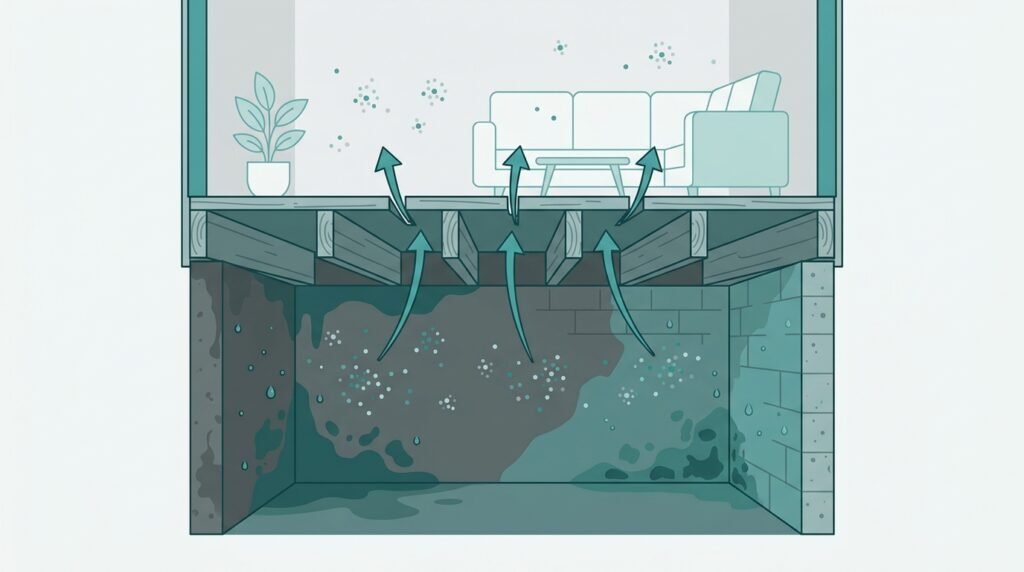
So the diagnostic flip is this. If what you have really is the species you are afraid of, that is a building finding rather than a poison finding. It means a cellulose material has been soaking for days or weeks, and you have a leak or standing water rather than a humidity problem. That is worth knowing, and it is actionable.
Conversely, the far commoner Cladosporium on cold masonry means condensation, and the repair is heat, insulation and dehumidification rather than excavation. The review notes this organism turns up in the places where water vapour condenses, at what it calls thermal bridges, which is a technical description of exactly what a cold basement wall is.
Should you get it tested?
A state health department answers this under its own heading, and the answer begins with the word no.
The regulator agrees that in most cases, if visible mould growth is present, sampling is unnecessary. And because no federal limits exist for mould or mould spores, a sample cannot be checked against any standard. There is no number for your result to be compared to.
Why a negative test is especially worthless here
Municipal remediation guidance states plainly that air sampling methods for some fungi are prone to false negative results and therefore cannot be used to definitively rule out contamination.
Now stack two facts on top of that. The allergy literature notes that Stachybotrys is poorly aerosolised. The mycology literature explains why: its spores are held in slime heads and are only released once dried out.
A wet colony of the exact organism people are testing for is among the least likely things to appear in an air sample. So a clean air test is close to meaningless for that specific question, which is the question the test was usually bought to answer.
What testing is legitimately for
- Finding mould you cannot see, where there is a musty smell but a visual inspection cannot locate it.
- Supporting a medical evaluation where somebody has been diagnosed with a condition that may be fungal.
- Checking a ventilation system suspected of being contaminated.
If air sampling is done, outdoor samples must be collected at the same time for comparison. A consumer settle-plate kit provides no outdoor control and no trained interpretation, which is most of why it tells you nothing.
On price we can only tell you what companies charge, because no independent body publishes figures. Treat any quoted range as vendor pricing.
What to actually do
Is this a DIY job?
| Situation | Response |
|---|---|
| Under about 10 square feet, roughly a 3 ft by 3 ft patch | In most cases you can handle it yourself |
| Larger than 10 square feet, or you are highly sensitive to mould | Bring in a contractor. Note that the second trigger has nothing to do with area |
| Heavy blanket coverage rather than patchy, or the work will make a lot of dust | Treat it as a bigger job than the square footage suggests |
| Anyone in the house is an infant under 12 months, recovering from surgery, immune suppressed, or has asthma or severe allergies | Moving them out of adjacent spaces during the work is recommended |
Doing it properly
- Fix the water first. The source of the water or dampness must be identified and corrected before anything else, or it comes back.
- Wear an N95 and gloves, with eye protection. The work area should be unoccupied.
- Mist, do not soak. Dust suppression by lightly misting surfaces before you disturb them is recommended, and it is the detail that separates a tidy job from spreading spores around the room.
- Throw away porous materials. Plasterboard, carpet, paper and ceiling tiles with extensive growth get discarded, not cleaned. Hard surfaces that are not rotten can be washed with soap and water.
- Nothing special is needed for disposal. Bag it and bin it.
Killing it is not the goal
That single sentence writes off an entire product category. It is also why sterilising is the wrong target: in most cases it is neither possible nor desirable, a background level of spores will remain, and those spores will not grow if the moisture problem has been resolved.
The bleach question, honestly
You will find both positions stated as fact. They are both real guidance, and the difference between them is a condition rather than a contradiction.
The regulator does not recommend it as routine:
A state health department permits it in a narrow case, and its own wording contains the limit:
Read together: bleach is not the answer, it does not substitute for removal, and where you can fix the damp it is largely pointless. Where you genuinely cannot, it is a holding measure. It is also useless on porous materials, which is why the same guidance restricts cleaning to hard surfaces that are not decayed.
Four things sold for this that do not work
- Foggers and mould bombs. The regulator wrote to manufacturers saying it was concerned that fogging and misting products may not be as effective as claimed, and required them either to produce efficacy data or drop the public health claims. A fogger addresses none of the three things that matter: removal, drying, and the water source.
- Ozone generators. The guidance here is unusually blunt. At concentrations that do not exceed public health standards, ozone applied to indoor air does not effectively remove viruses, bacteria, mould or other biological pollutants. And when inhaled, ozone can damage the lungs. For anyone with asthma this is worse than doing nothing.
- Hardware store test kits. No benchmark to compare the result to, no outdoor control, no trained interpretation, and a known tendency to false negatives for the organism you care about.
- Painting over it. Do not paint or caulk mouldy surfaces. Clean up the mould and dry the surfaces before painting, because paint applied over mouldy surfaces is likely to peel.
One more, aimed at your wallet rather than your wall. Urine mycotoxin tests and mould antibody panels are marketed heavily online. The toxicology position is that it is inappropriate to attribute mycotoxins found in urine to supposed remote inhalation exposure, and that the associated detox protocols are medically inappropriate and costly.
FAQ
How do I know if it is really black mould?
You cannot tell by looking, and a laboratory result would not change what you do. What would change your repair is knowing whether the wall has been genuinely wet or merely humid, and you can work that out yourself from the moisture pattern.
Do I need to leave the house?
For a patch under about ten square feet, no. Keep the work area unoccupied while you clean, and move an infant, an immune-suppressed person or someone with asthma out of adjacent rooms during the work.
I have had symptoms. Was it the mould?
Possibly, through allergy or irritation, which are the common mechanisms. Worth noting that irritant effects are transient, so symptoms persisting for weeks after exposure, or accompanied by neurological or systemic complaints, should not be attributed to irritation. See a doctor and tell them about the damp.
Is black mould worse than green mould?
Not in any way that changes your response. Colour does not identify species, species does not change the cleanup, and the health guidance treats any indoor growth the same way.
Should I be more worried because I have children?
Take it seriously, and for the damp rather than the toxin. The precautionary advice is that infants under a year should not be in chronically mouldy, water-damaged spaces, and the strongest evidence across the field is for asthma exacerbation in children. That is a reason to fix the moisture promptly rather than to panic about the species.
If it is not toxic, why bother fixing it?
Because damp indoor spaces present real health risks through allergy, and because the same guidance that dismisses the toxin story recommends that chronic moisture be remediated as soon as possible. The mould is also telling you a building is wet, and wet buildings decay.