Last Updated on August 25, 2026 by Umar Farooq
A basement that is dry for weeks and then wet after one storm is not a mystery. It is a specific, diagnosable pattern, and the intermittency is the most useful clue you have.
Two things have to line up for water to arrive. There has to be more water than the ground around your house can take away, and there has to be a route in. Change either one and the basement stays dry, which is exactly why some storms do it and others do not.
How much water are we talking about?
Start with the roof, because it is the largest collector on the property and the one people forget.
Rainfall converts to volume at about 0.623 gallons per square foot per inch of rain. Run that on an ordinary house and the number stops being abstract: a single inch of rain on a 2,000 square foot roof is roughly 1,250 gallons.
All of it lands within a few feet of your walls unless something moves it further. That is the whole job of gutters and downspouts, and it is why a blocked gutter is not a cosmetic problem.
Why some storms and not others
This is the part no page on this topic explains, and there are two separate mechanisms.
| Mechanism | What happens | Storm type that triggers it |
|---|---|---|
| The rain arrives faster than the soil can take it | Water cannot infiltrate quickly enough, so it runs across the surface instead. If the ground slopes toward the house, it runs to your wall. | Short, intense downpours. A lot of rain in an hour. |
| The soil is already full | Rain infiltrates normally until the surface layer saturates. After that everything additional runs off or builds pressure against the foundation. | Long, steady rain. Or a moderate storm following a wet week. |
There is a formal version of the same idea. Runoff modelling uses an antecedent runoff condition precisely because the same soil behaves differently depending on how wet it already was. The runoff figure for a given site is not a constant, and varies from storm to storm and even within a storm.
Practical consequence: the storm that floods your basement is often not the biggest one of the year. It is the one that followed a wet fortnight.
The clay bowl
Here is the mechanism that explains why a basement can be surrounded by heavy clay and still take on water.
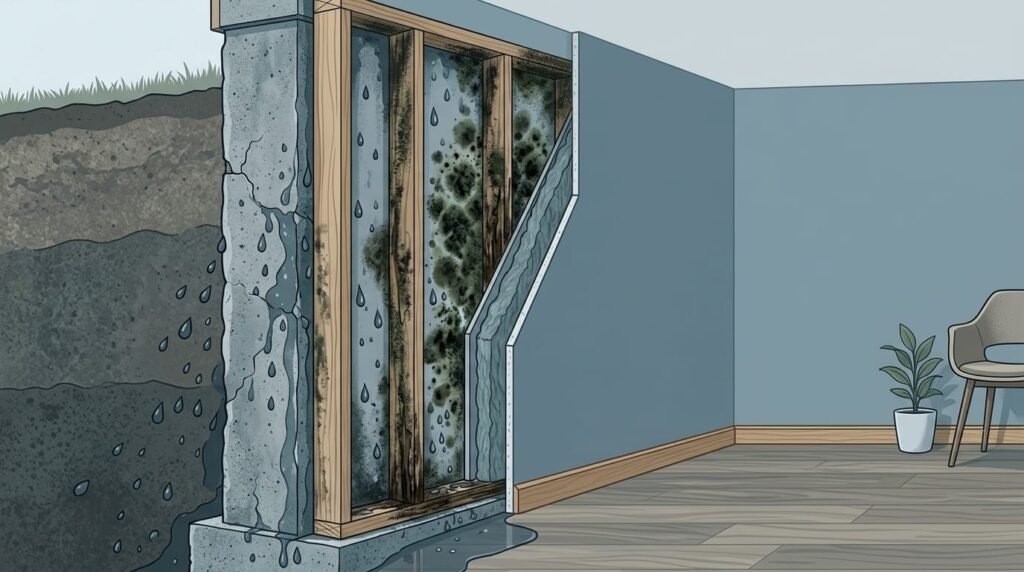
When the house was built, a hole was dug in the native soil and backfilled around the walls. That backfill is looser and far more permeable than the undisturbed ground around it. So the excavation behaves as a bowl: water reaches it easily, and then cannot get out.
The permeability difference is not marginal. Published figures put clean gravel at around 22,500 feet per day and clay at 0.0003. That is a spread of roughly 75 million to one between what your backfill can pass and what the surrounding ground will accept.
Water runs along the surface toward the basement. Because the builder has backfilled this area with sand, the water rapidly penetrates the backfill, establishing a hydrostatic head outside the wall.
The footings usually sit directly on the native clay, which blocks the last escape route downward. Water collects, and every foot it stands against the wall adds pressure. Water weighs about 62.4 pounds per cubic foot, which works out at roughly 0.43 psi for every foot of standing head. Building codes require saturated soil pressures to include the hydrostatic load on top of the soil load for exactly this reason.
Trace the entry point
Go down during or immediately after the next storm. This is the one time the evidence is visible, and it is worth setting an alarm for.
| Where you see it first | What it means |
|---|---|
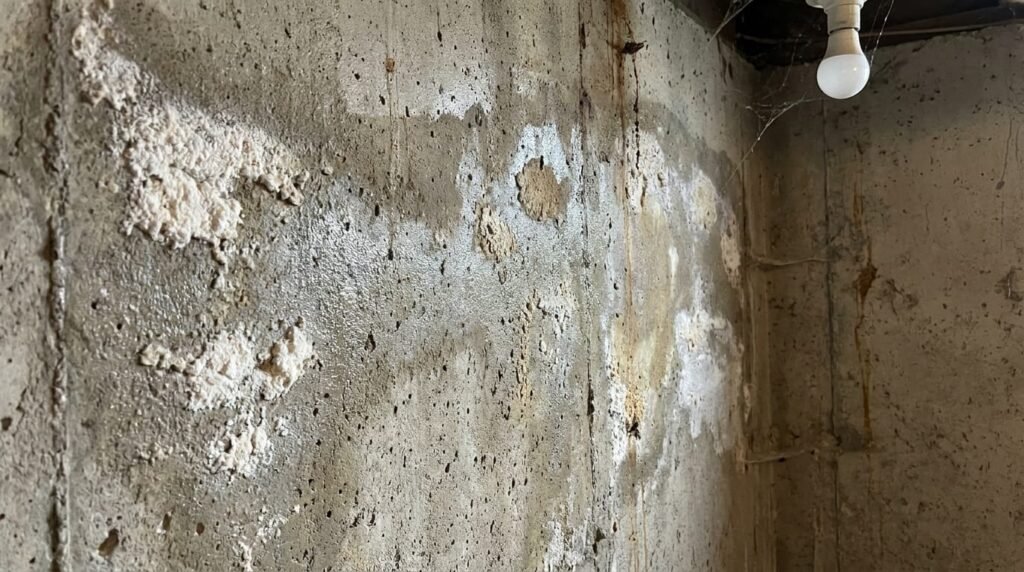
| The joint where the wall meets the floor | The most common route. Water is under the slab or against the footing and coming up through the joint. |
| A crack in the wall | Direct path. Note whether it runs vertically or diagonally, and whether it is wet along its whole length or only lower down. |
| A window well | The well has filled faster than it drains. Check the drain at the bottom before anything else. |
| Through the middle of the floor | Pressure under the slab, or a crack in it. Usually the water table rather than surface water. |
| High on one wall | Surface water, not groundwater. Look directly outside that spot for a downspout, a path sloping the wrong way, or a patio draining back. |
| Everywhere at once | Volume problem rather than a single defect. Start outside. |
Also note the delay. Water appearing within an hour of the rain starting points to surface water arriving directly. Water appearing a day later points to the ground around the house saturating and the water table rising.
Fix the outside first
A 1966 study of more than 130 houses with a history of basement leakage, reported by the US Forest Service in 1978, found that 85% of leakage cases occurred after rainstorms. The same paper is blunt about what that implies:
Some of the traditional means of preventing basement leakage are ineffective. Far more important than the use of sealants and drain tile are the control of water through effective surface drainage.
The checkable specifications, all of which cost little or nothing to correct:
- Grading. The ground should fall at least 6 inches within the first 10 feet from the wall. Older guidance puts it at half an inch to an inch per foot for 8 to 10 feet, which is the same idea.
- Downspouts. At least one per 50 linear feet of roof eave, discharging a minimum of 4 feet from the wall.
- Gutters. Blocked gutters overflow at the wall, which concentrates the entire roof catchment into one spot.
- Settled backfill. The soil next to the house was backfilled and has since settled, often forming a dip that collects water. Under steps and porches is the usual place.
- Hard surfaces. Patios, paths and driveways within 10 feet should slope away at 2% or more.
Frozen ground and snowmelt
Worth knowing if you get winters, and worth getting right, because the popular version overstates it.
At the scale of a whole watershed, the assumption that frozen soil blocks infiltration and drives runoff has not held up well in the research. At the scale of a single yard, it does. The enhancement of runoff due to soil frost is evident on small plots and in extreme events, such as rain falling on frozen, snow-free ground.
Your garden is a small plot. Rain on frozen ground, or a fast thaw with rain on top, will run across the surface rather than soak in. Weather service outlooks track frost depth for the same reason: shallow frost lets meltwater infiltrate, deeper frost sends it downhill.
When it is worth spending money
Work outward from free, and only escalate when the cheaper step has been done and tested through a real storm.
- Clear the gutters and extend the downspouts. Costs almost nothing.
- Correct the grading and fill settled hollows against the wall.
- Fix window well drainage and cover the wells.
- Seal individual cracks, if a specific crack is the demonstrated route.
- Only then consider a drainage system, and expect a serious quote.
The reason for that order is not thrift for its own sake. If you install drainage while a downspout is still discharging against the wall, you have paid to manage a problem you could have removed.
FAQ
Why is my basement wet after rain but dry after snow?
Snow releases its water slowly, so the ground has time to absorb it. A fast thaw with rain on top behaves like a heavy storm and often does wet the basement.
It only happens in really big storms. Do I still need to fix it?
If the entry route exists, it will be used again, and storms of that size are not getting rarer. But the fix may be a $20 downspout extension rather than excavation, which is a reason to diagnose rather than ignore.
Should I seal the crack water comes through?
Only after you have dealt with the water reaching it. Sealing a crack while the same volume of water still arrives usually moves the leak somewhere else, because the pressure has not changed.
My neighbour has the same soil and no problem. Why me?
Almost always drainage rather than geology. Roof area, gutter condition, downspout placement, grading, patios and settled backfill differ house to house even on identical plots.
Can a sump pump keep up with a storm?
A working one usually can, provided the discharge runs well away from the house. If the outflow lands near the foundation you are recycling the same water back through the system.