Last Updated on August 24, 2026 by Umar Farooq
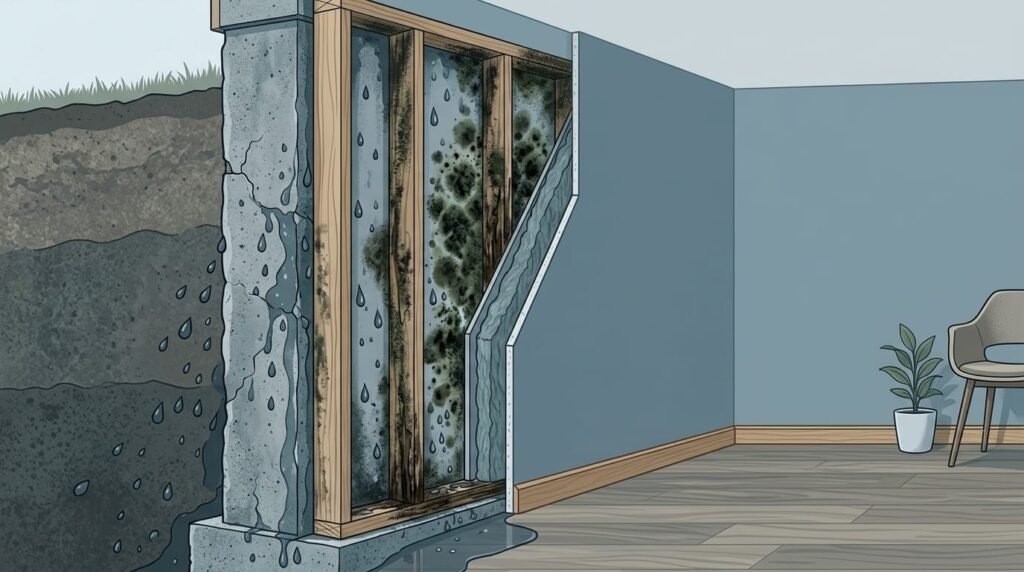
A damp patch on finished basement drywall has two very different explanations. Either a pipe is leaking, or water is coming through the foundation. The repairs are unrelated and so are the tradespeople.
Search this problem and you get two separate answers, neither of which adjudicates. Plumbing and restoration companies assume a pipe. Waterproofing companies assume groundwater. Both are guessing, and both sell the fix for their guess.
Here is how to work out which one you have before anyone quotes you.
Start with the water meter. It is free and it settles a lot.
A supply pipe is pressurised. If it is leaking, water is moving whether or not anyone is using a tap. Your meter can see that.
- Turn off every fixture and appliance that uses water. No dishwasher, no washing machine, no ice maker.
- Read the meter, or note the position of the small leak indicator dial.
- Wait two hours without using any water.
- Read it again.
The EPA instruction is to check the meter before and after a two-hour period with no water use. Any movement at all means water is escaping somewhere on the pressurised side.
If it moved, you can narrow it further. Shut off the main valve where the supply enters the house, then watch the meter again. If it stops, the leak is inside. If it keeps running, the leak is outside, between the meter and the house.
The exception nobody mentions
A still meter does not clear you. Waste and drain lines are not pressurised, so a leaking drain, a condensate line, or a shower pan will not move the meter at all. Neither will groundwater. The meter test rules out one category of leak, not all of them.
The signs, in the order they usually appear
Behind a finished wall, water announces itself slowly. These are roughly the sequence you get, and the early ones are easy to walk past.
| Sign | What is actually happening |
|---|---|
| A smell before anything is visible | The back face of the board is wet and something is growing on the paper. Paper facing is organic, so it feeds mould long before the front shows a mark. |
| Baseboard lifting slightly, or paint hairline-cracking at the bottom | Timber and paper swell as they take up moisture. The bottom of the wall moves first because water runs down inside the cavity. |
| Rust marks at fastener heads | Steel screws and nails corrode in a damp cavity and bleed through the compound. This is the single most reliable early visual sign. |
| Tape seams showing as faint lines | Joint compound absorbs moisture at a different rate to the board, so seams telegraph through the paint. |
| A soft or spongy patch under finger pressure | The gypsum core has taken up water. At this point the board is usually not saveable. |
| A visible stain | Late. By the time a stain shows on the painted face, the cavity has been wet for a while. |
Then watch the weather for a fortnight
This costs nothing and it separates the two main causes cleanly.
| What you observe | What it points to |
|---|---|
| Damp appears or worsens within a day or two of heavy rain | Groundwater or surface water. A pipe does not know it is raining. |
| Damp is steady in dry weather with no rain correlation | Plumbing, or a permanently high water table. |
| Damp worsens in humid weather but the wall is dry after rain | Condensation, not a leak at all. |
| Damp appeared suddenly and has not stopped | Plumbing. Groundwater problems usually build over seasons. |
Read the pattern on the wall
Where the damp sits tells you where the water came from.
- A vertical drip track, narrow, running down from a single point, usually centred near a fixture or a pipe run. That reads as plumbing.
- A horizontal band at or just above the floor, wider than any fixture, often along more than one wall. That reads as seepage at the wall-floor joint.
- White streaking below a joint or crack tells you water entered the wall higher up and ran down. Masonry industry guidance treats heavy localised streaking as evidence that water has entered at a higher elevation, as opposed to the uniform bloom you get from construction moisture.
- A warm patch on the floor or wall. A hot water supply line heats the material around it. Warmth plus a moving meter is a hot water line, and that is unambiguously plumbing.
What your detection tools actually measure
This is where most advice goes wrong, including advice from companies selling the inspection.
| Tool | What it really measures | Where it fails |
|---|---|---|
| Moisture meter (pin or pinless) | Electrical resistance or capacitance, not water. On anything other than wood it reports a wood moisture equivalent, which is a comparison, not a percentage of water in your wall. | Dissolved salts conduct. A basement wall with efflorescence reads high even when dry. Building research guidance states plainly that high readings can come from a wall with high salt concentration even if the wall is virtually dry. |
| Pinless meter specifically | Capacitance to a shallow depth below the surface. | Measured penetration across four commercial meters ranged from about 9 mm to 59 mm. The common claim that pinless meters read three quarters of an inch is model-specific, not a property of the category. All of them read higher when there is metal or framing behind. |
| Thermal camera | Surface temperature. Nothing else. | The manufacturer says it directly: a thermal camera cannot see moisture in walls, only temperature differences that may indicate it. The moisture signal is often a fraction of a degree, and in plaster it reaches only about 1.5 cm deep. Metal studs, insulation gaps and sunlight on the other side of the wall all look the same. |
| Acoustic leak detection | Noise generated as pressurised water escapes an orifice. | Needs pressure. It cannot find a drain leak, a condensate line, or groundwater. |
If you do use a moisture meter, use it comparatively rather than absolutely. Take a reading on a part of the same wall you know is dry, then compare. Researchers testing meters on gypsum board recommend taking three readings about 10 cm apart and using the lowest, to reduce interference from whatever sits behind the board.
Numbers you can act on
- A leak one thirty-second of an inch across can waste about 6,300 gallons a month. That is a hole you could not see through drywall, and it explains how a wall gets soaked with no dramatic event.
- The average household leaks account for more than 9,300 gallons a year, and about nine percent of homes have leaks wasting 50 gallons or more per day.
- Wet materials that are dried within 24 to 48 hours will, in most cases, not grow mould. Past that window, assume you have a second problem behind the board.
Note on those figures: older versions circulate widely, usually quoted as 10,000 gallons, ten percent of homes and 90 gallons a day. Those are retired numbers. The current ones are above.
Water stains on the concrete floor
A stain on the slab is a separate reading, and it tells you about water that has already been and gone.
The important thing is to identify it before you scrub. Two different marks look similar:
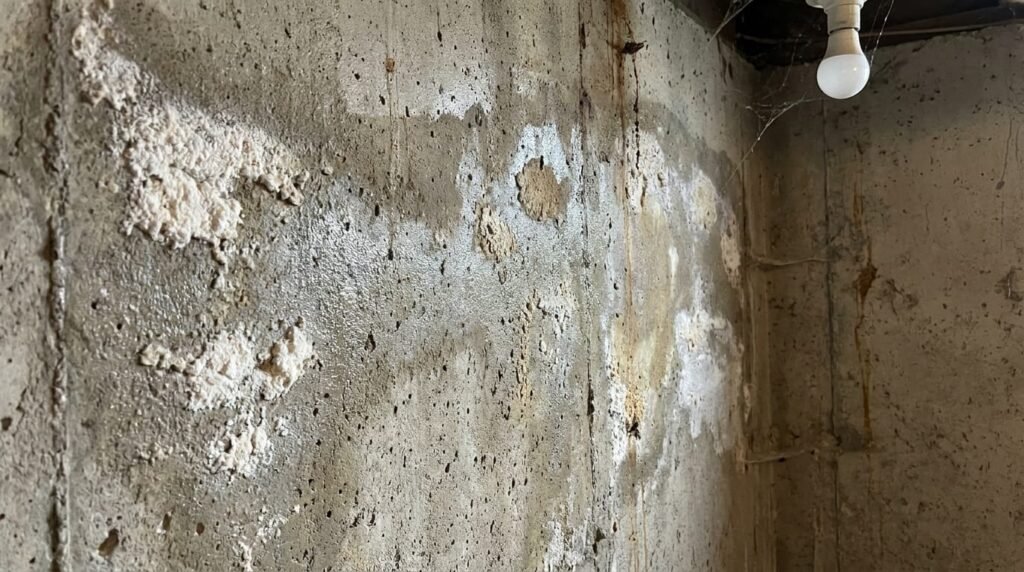
- A mineral deposit, chalky, sitting slightly proud of the surface, often white or off-white. This is salt left behind as water evaporated out of the slab. Scrubbing removes the deposit and does nothing about the moisture that delivered it.
- A darkened patch with a defined tide line, where the concrete itself has been discoloured. That is staining from whatever was in the water: soil, rust, or organic matter.
Where the stain sits is diagnostic. A patch tight against the wall-floor joint points to seepage at that joint. A patch out in the middle of the floor, with no path from a wall, points either to moisture rising through the slab or to something that leaked above it.
If you want to remove it, the order matters: fix the water first, let the slab dry, then clean. Cleaning a slab that is still taking on moisture just brings more salt to the surface, and washing it adds water to the thing you are trying to dry.
Opening the wall
At some point looking beats measuring. Do it in this order.
- Turn off the circuit feeding that area at the breaker. Non-contact voltage testers do not detect cable that is not energised, so do not rely on one alone.
- Take the cover off the nearest outlet or switch. You can often see and feel into the stud bay without cutting anything.
- If you still need access, drill a single hole about three quarters of an inch, low on the wall behind where the baseboard sits, inside one stud bay. Use an inspection camera through it.
- Enlarge only if you have to. A small hole patches invisibly behind a baseboard.
One warning before you start pulling things apart: removing wallpaper can release a large quantity of spores at once if mould is growing on the underside. If you suspect a substantial hidden mould problem, that is the point to bring somebody in rather than open it yourself.
Deciding who to call
| What the evidence says | Who you want |
|---|---|
| Meter moves with everything off | Plumber, or a leak detection specialist if the location is unclear |
| Meter still, damp tracks rainfall | Damp or drainage contractor. Fix surface water and grading first. |
| Meter still, damp is constant, no rain link | Plumber first, for drains and waste rather than supply |
| Damp only in humid weather, sheet test wet on the room side | Nobody yet. This is condensation and it is a humidity problem. |
| Large area of mould behind the board | Remediation, after the water source is identified |
One thing to know going in. The professional standard restoration firms work to, IICRC S500, is a paid document. You cannot read it to check what they tell you it requires. That is worth remembering when a quote is justified by reference to it.
FAQ
Can I have a leak if my water bill is normal?
Yes, if it is a drain leak or groundwater. Neither passes through the meter. A normal bill only rules out a significant supply leak.
The wall is damp but the drywall looks fine. Is that possible?
Common. Paint and paper hold their appearance for a while, and the back face gets wet long before the front shows it. Check whether fasteners have rusted, and feel for softness rather than looking for stains.
Do nail pops mean water?
Usually not. Gypsum industry guidance attributes them to timber shrinkage and fastening errors rather than moisture. The moisture tell is rust on the fastener head, not the pop itself.
Is the white powder on the wall mould?
Almost certainly not if it is on masonry. It is mineral salt carried out of the wall by moisture. It also matters for diagnosis, because it will push your moisture meter readings up.
How long can I leave it before opening the wall?
If the material is actually wet, the useful window is 24 to 48 hours. After that you are no longer only chasing a leak.