Last Updated on August 25, 2026 by Umar Farooq
Condensation and water coming in through the structure look almost identical on a basement wall, and they need opposite fixes. Treating condensation as a leak means digging up the outside of your house for nothing. Treating a leak as condensation means running a dehumidifier forever against water that keeps arriving.
Every guide to this describes what each one looks like. Almost none gives you a test. Below are three you can run yourself, in order of how decisive they are.
Test 1 — The 24-hour sheet test
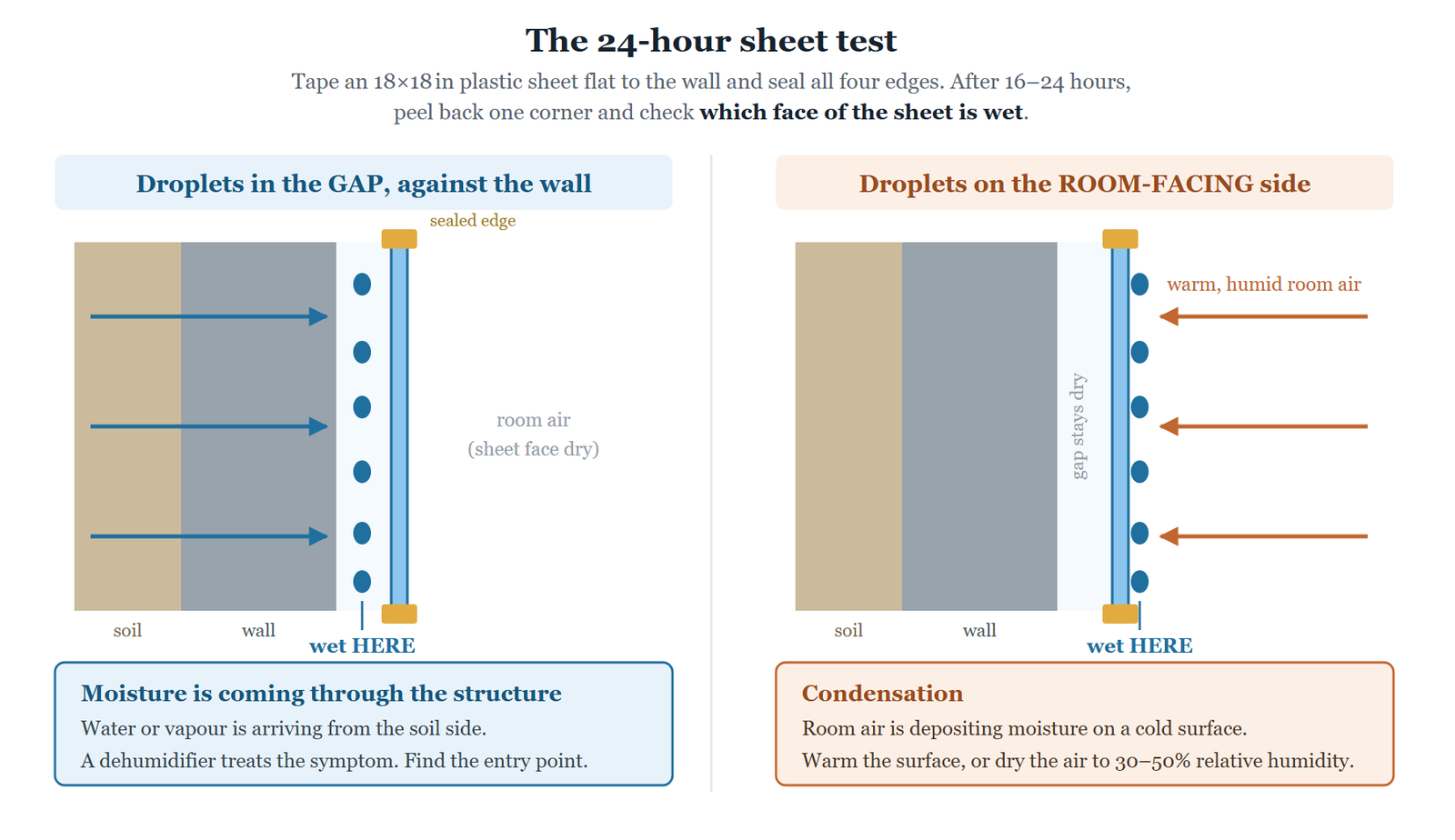
This is the closest thing to a definitive answer available without a lab, and it is the consumer version of a recognised standard method for detecting capillary moisture in concrete (ASTM D4263).
- Pick the damp area. Wipe it and let the surface dry as much as it will.
- Tape a square of clear plastic sheet or aluminium foil — about 18 in × 18 in — flat against the surface.
- Seal all four edges with wide tape. The seal is the test; a leaky edge gives you nothing.
- Leave it at least 16 hours, and 24 is better.
- Peel back one corner and look at both faces of the sheet and the surface underneath.
| What you find | What it means |
|---|---|
| Moisture on the face against the wall, or the surface under it is damp | Moisture is coming through the structure. Water or vapour is arriving from the soil side. |
| Moisture on the room-facing side of the sheet | Condensation. The moisture is coming out of the room air onto a cold surface. |
| Both faces damp | Both are happening. Common, and it means the humidity work will not be enough on its own. |
| Neither — sheet and surface dry | Whatever is wetting the wall was not active during the test. Repeat it after heavy rain, or in the most humid weather you get. |
Test 2 — The dew point check
Condensation happens when a surface is colder than the dew point of the air touching it. That is a number you can check with a cheap hygrometer and an infrared thermometer.
- Measure the air temperature and relative humidity in the room.
- Look up the dew point for that combination, or use any dew point calculator.
- Measure the temperature of the coldest surface — usually the wall low down, a corner, or a pipe.
- If the surface is at or below the dew point, condensation is forming there. That is not an opinion, it is physics.
A published building-research case makes the point well: a homeowner was convinced they had a roof leak. Measurements showed room air at 16 °C, wall surface at 14.5 °C, the damp patch itself at 13.5 °C, and relative humidity around 85% — giving a dew point of 13.7 °C. The damp patch was colder than the dew point. It was a cold spot in the structure, not a leak.
If the coldest surface in the room is below the dew point of the room air, you do not have a mystery. You have condensation, and a thermometer proved it.
Two levers follow directly from this, and they are the only two: raise the surface temperature (insulate, improve air circulation) or lower the moisture in the air (fix leaks, ventilate sensibly, dehumidify). Aim for relative humidity below 60%, ideally 30–50%.
Test 3 — What the timing tells you
When the damp appears is a strong signal, and it costs nothing to observe.
| Pattern | Points to |
|---|---|
| Appears or worsens within a day or two of heavy rain | Water entry — surface water, drainage, or hydrostatic pressure |
| Worst in warm humid weather, better in winter | Condensation. Warm outdoor air meeting cool foundation surfaces |
| Worst in cold weather, on the coldest surfaces | Condensation from indoor moisture on cold spots — a different season, same mechanism |
| Constant, no weather pattern | A plumbing leak, or a slab with no vapour barrier under it |
| Follows a tide-mark band low on the wall, fairly level, all year | Possible rising damp — but see the section below before accepting that |
Worth knowing how much water is in play. A one-inch rainfall on the roof of a 2,000 sq ft house delivers roughly 1,250 gallons. If the gutters, downpipes or ground slope are not moving that away from the wall, that is your leak, and no interior work will fix it.
Why a moisture meter can mislead you
If a surveyor waves a pin meter at your wall and shows you a high number, understand what that number is. Electrical resistance meters are calibrated on oven-dried wood and report a “wood moisture equivalent” — the moisture content wood would reach in equilibrium with the material being tested. A reading of 18% on masonry does not mean the wall is 18% water.
More importantly, dissolved salts in masonry conduct electricity, which drives the reading up regardless of how wet the wall is. This is not a fringe claim — a meter manufacturer’s own technical blog states that the presence of salt makes a material seem more inundated by moisture than it is, that accumulating surface salts worsen the error over time, and that masonry is particularly prone because mortar often contains higher sodium levels than other building materials.
So a wall that was damp years ago, was treated, and has dried can still read high forever, because the salts stayed behind. A high meter reading on its own is not proof of anything.
The white powder trap
Everyone says white powdery deposits mean rising damp. The trade body for damp contractors publishes guidance that complicates this considerably.
- Salts that are visible as efflorescence are seldom hygroscopic and are usually sulphates — so the white fluffy stuff being pointed at is often the wrong salt.
- The salts that genuinely indicate rising damp are chlorides and nitrates, which are typically not visible.
- Hygroscopic salts can pull enough moisture straight out of the air that the wall becomes visibly wet — an effect described as entirely separate from capillary rise.
- Salt can also arrive from a chimney flue, which produces damp staining on chimney breasts at upper floor levels, where rising damp cannot reach.
The recognised way to actually settle it is sampling: measure total moisture, measure how much of it the material absorbs hygroscopically from the air, and the difference is the capillary moisture. If those two numbers are about the same, the wall is wet from air, not from the ground. That requires a lab, which is why nobody selling you a treatment on the day has done it.
About rising damp
Rising damp is real physics — water moving up through porous masonry by capillary action — and it is also, by the account of several non-commercial heritage bodies, diagnosed far more often than it occurs.
The physics constrains it more than the marketing suggests. The steady-state height depends on the balance between how fast water is absorbed and how fast it evaporates from the wall face: it rises with the square root of wall thickness and falls with the square root of the evaporation rate. In a worked example for a 150 mm limestone wall under UK conditions, that comes out around 0.61 m. Doubling the wall thickness to 300 mm only takes it to about 0.87 m.
Two consequences that contradict common practice:
- Reducing evaporation raises the damp front. Rendering or tanking over the affected area drives the wet front higher, and it can take well over a year to reappear above the new render. The research describing this concludes that, taken alone, it is a poor treatment.
- A band much above a metre is probably not rising damp. Buildings without a damp-proof course typically show a saturated band in the 0.5–1 m range.
On prevalence, we would rather be straight with you than confident: figures of roughly 4% and roughly 10% of investigated cases both circulate, both attributed to UK building research, and we could not trace either to a public primary source we could verify. What is well documented is the direction — a UK conservation charity states plainly that rising damp is rarer than often supposed and widely misdiagnosed on the basis of high electrical moisture meter readings alone, noting that elevated readings occur in old buildings that are virtually dry because of salt deposits.
For most US basements, rising damp is not the first thing to suspect. Poured concrete and block foundations behave differently from old solid masonry, and the far more common causes are surface water, drainage, and condensation.
If it is water coming in, where from?
In rough order of likelihood and cost to fix:
- Surface water. Gutters, downpipes discharging at the wall, ground sloping toward the house. Cheapest to fix and most often the answer.
- Capillary suction from wet soil. Soil type matters a great deal here — published extension figures put capillary rise at less than a few inches in gravel, 1–8 feet in sand, and 12–20 feet in silt and clay.
- Vapour diffusion through the structure. Slow, constant, worst without a vapour barrier under the slab.
- Air movement carrying moisture onto surfaces below the dew point — which loops back to condensation.
Note that new concrete also releases its own water for a long time. Extension guidance puts it at roughly 0.2 gallons per square foot of wall and 0.1 per square foot of floor, taking many months or even years. A new-build basement that feels damp may simply not have finished drying.
One thing to watch for in a survey
A joint position statement adopted by UK surveying and conservation bodies — including the damp contractors’ own trade association — sets out how moisture investigation should be done. Two of its requirements are worth carrying into any conversation with a contractor:
- Diagnosis should be holistic, identifying and dealing with causes rather than symptoms.
- Obvious defects should be fixed first, followed by a period of monitoring and natural evaporation, and reassessment before moving on to other treatments.
- And, in the reporting section: “Any conflicts of interest should be clearly stated.”
That last line is in a document co-signed by the trade body for damp-proofing contractors. A same-day diagnosis that ends in a quote for a chemical damp-proof course, with no monitoring period and no sampling, does not meet the standard the industry set for itself. Our questions to ask a damp specialist guide covers the rest of that conversation.
FAQ
Can I have condensation and a leak at the same time?
Very commonly, yes — and it is why single-cause diagnoses go wrong. Water coming in raises the humidity of the room, which then condenses on the coldest surfaces elsewhere. Fix the entry first, then reassess the humidity.
Will a dehumidifier tell me which one I have?
Roughly. Run it hard for a week with the space closed up. If the walls dry out and stay dry, you were dealing with air moisture. If a patch stays damp while the room air is at 45%, something is feeding that patch from behind.
Should I just tank or seal the walls?
Not before you know the cause. Sealing a wall that has water arriving behind it moves the problem rather than solving it, and in the rising damp case reducing evaporation can push the damp front higher up the wall.
Does a high moisture meter reading prove I need a damp-proof course?
No. Meters are calibrated on wood, report a wood-equivalent figure, and read high on salt-contaminated masonry even when it is dry. It is a screening tool for finding where to look, not proof of a mechanism.
How long should I monitor before deciding?
Long enough to see the pattern — ideally across a rain event and a humid spell. A cheap logging hygrometer left in the basement for a few weeks will tell you more than a single visit, and it is the approach building researchers use themselves.