Last Updated on August 25, 2026 by Umar Farooq
Every page ranking for this question is published by someone who profits from the answer “yes, waterproof it”. Waterproofing contractors, an agent-referral platform, and a realtor trade body.
What is missing from all of them is the part that actually decides this: the disclosure form you will have to sign, what the inspector is allowed to write, and what your buyer’s lender does when the appraiser uses the word “dampness”.
One caveat before anything else, and it is a real one. Seller disclosure law in the US is state-specific and the differences are enormous. Everything below names the state it comes from. None of it is legal advice, and if money is at stake you should get some.
You are going to have to disclose it
The forms are statutory and the questions are specific. Ohio’s asks:
Illinois asks you to state whether you are aware of flooding or recurring leakage problems in the crawl space or basement, and separately whether you are aware of material defects in the basement or foundation including cracks and bulges.
New York’s form, in capitals, asks whether the structure has experienced any water penetration or damage due to seepage or a natural flood event.
Minnesota has no itemised form and instead imposes a general duty to disclose all material facts of which the seller is aware that could adversely and significantly affect an ordinary buyer’s use and enjoyment of the property. A wet basement plainly qualifies.
And at the other extreme, Virginia’s statutory form is titled for the buyer to beware and consists of paragraphs each beginning “the owner makes no representations”. There is no water question on it at all. Three states, three completely different legal situations for the same wet basement.
Fixing it does not give you a clean form
This is the single most common piece of bad advice in this market, and the page ranking second for it says so explicitly, telling sellers that waterproofing before sale “will, first of all, enable the homeowner to present a clean disclosure statement”.
Read the Ohio question again. It asks about previous or current water, and then asks you to list the repairs. The form is built so that fixing the problem cannot clear it. Illinois asks what you are aware of. New York asks what the structure has experienced, in the past tense.
So the honest position is that a pre-sale repair changes your disclosure from “yes, and it is unresolved” to “yes, and here is what I did about it three weeks ago”. That is a better disclosure. It is not an absent one.
And “as is” does not help
A Pennsylvania appellate court addressed exactly this. The contract said the buyer was purchasing as is and expressly waived all implied warranties. The court held that the disclosure law contains no exceptions:
The seller paid $39,000 at trial, and the appeal court held the trial court had under-calculated it. The damages measure is worth knowing because it is the same arithmetic as your repair quote: actual damages may be determined by the repair costs, capped by the market value of the property.
Every disclosure statute we read has a savings clause preserving common law fraud. Minnesota’s says nothing in the act precludes liability based on fraud, negligent misrepresentation, or other actions allowed by law. New York’s says nothing in the article limits any existing cause of action or remedy. The statutory remedy is the floor, not the ceiling.
On the clock: Minnesota gives a buyer two years from closing to bring the statutory action, and the preserved fraud claims generally run longer.
The inspector will find it, and is forbidden from bounding it
Here is a mechanic nobody explains, and it is why a modest damp patch turns into a large renegotiation.
The home inspector’s own standard of practice lists what he is not required to determine. Among the items:
The causes of conditions and deficiencies. Methods, materials, and costs of corrections.
Mould and mould-like substances are excluded too, as are soil conditions relating to geotechnical or hydrologic specialties.
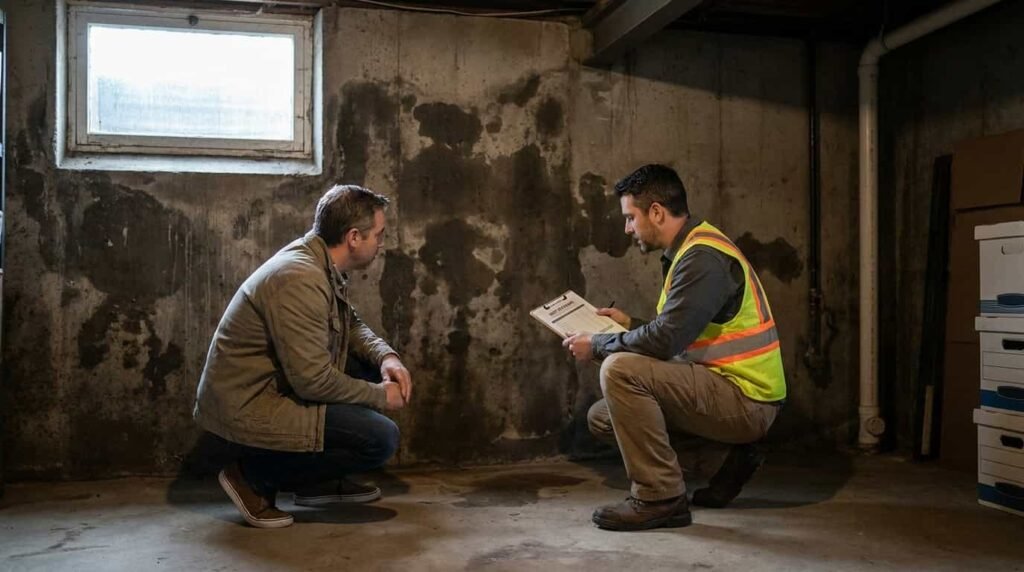
So the inspector writes “evidence of water penetration at the north foundation wall, recommend evaluation by a qualified specialist”. He is not permitted to tell the buyer what caused it, what it costs, or how bad it is. The report does not answer the buyer’s question. It escalates it.
The buyer is handed a defect with no upper bound and sent to a specialist to get one. That specialist sells waterproofing, and their commercial interest is in the largest defensible scope. That is the pipeline, and it starts with an exclusion in a standards document.
The part that actually decides it: your buyer’s lender
This is the finding that reframes the whole question, and it is publicly readable and completely absent from this market.
The dominant mortgage buyer’s selling guide contains a subsection titled “Infestation, Dampness, or Settlement”. Damp is named alongside termites and abnormal settlement.
Read what that does. It is not a valuation haircut. The appraisal comes back subject to, and the loan cannot close until the seller either proves the condition was corrected or produces a professional report saying it is not structural.
So a buyer with a conforming loan cannot simply choose to accept a damp basement and a discount. Their lender decides, not them. And at the severe end, a property rated in the worst condition category is not eligible for sale to that buyer at all, and any such deficiency must be repaired before the loan is sold. Note also that if any portion of the dwelling is rated at that level, the whole dwelling is.
Which reframes the question entirely. It is not “does waterproofing pay for itself”. It is “can my buyer’s lender close on this”. And that turns on facts you can check: whether your likely buyer is cash, portfolio, or conventionally financed.
Does fixing it pay? Nobody actually knows
We went looking for the return-on-investment figures this market quotes, and none of them survives contact.
| The claim | What is actually behind it |
|---|---|
| “About 30% ROI” | Traced to a home services directory being cited by an agent-referral platform. No dataset, no methodology, no sample |
| “Increases home value 10 to 15%” | Attributed across the market to a home improvement publisher. The only verifiable reference from that publisher is about reapplying waterproof paint every 5 to 10 years. The claim has drifted off its source |
| “200% return” | A single anecdote on a contractor site with no comparable sales and no address |
| “88% of buyers would not buy a home needing foundation repairs” | Originates with a national waterproofing firm. No sample size, fielding date or instrument published anywhere |
And the standard dataset does not measure it
The reference work for renovation returns is the annual Cost vs. Value report, which compares average costs for 28 remodeling projects across 119 US markets.
We pulled the full project list. It runs from garage doors and entry doors through kitchens, baths, roofing, windows, siding, decks and additions. It includes Basement Remodel, at about 72 percent nationally.
It does not include basement waterproofing. We searched the published report for “waterproof”, “foundation”, “drain”, “sump” and “moisture”. Zero occurrences of any of them.
So the single most-cited independent dataset on remodelling returns, covering 28 projects in 119 markets, does not track this work at all. Anyone quoting you a Cost vs. Value figure for basement waterproofing is quoting something else.
Transferable warranties are the same story. Every claim that one adds resale value comes from a company that sells the warranty. No appraisal literature or lender guidance treats it as a value adjustment, and the lender’s question is not about a promise for the future but about evidence that the condition was corrected.
The alternative, and why it may not be available to you
Disclosing and pricing accordingly is a legitimate strategy and it is now completely normal. Seller concessions were given in 46.2% of US home sales in the three months to the end of May 2026, the highest share for that month on record, and concessions include money toward repairs. Sixteen percent of sales had both a concession and a price drop.
But note the asymmetry, because it is the practical crux of this page. A closing credit pays for work done after closing. An appraisal that comes back subject to repairs needs the work evidenced before closing. The credit route only works if the appraiser does not flag it, and you do not control that.
The lead paint problem nobody connects to this
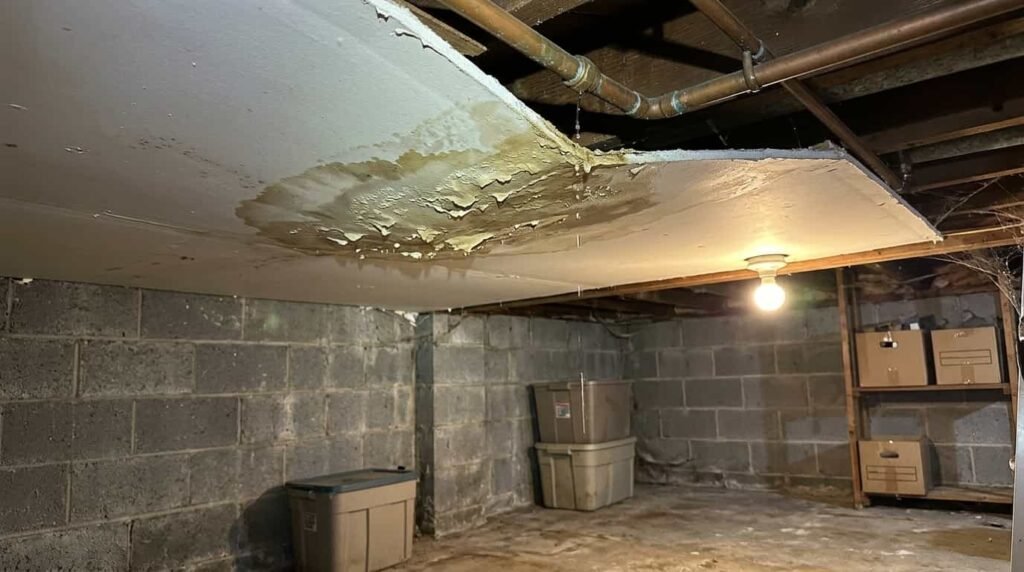
Damp basements produce peeling paint. That is what damp does to paint. And peeling paint in an older house triggers a separate, mandatory, federal disclosure that has nothing to do with your state form.
The regulator defines the hazard precisely as deteriorating paint, which it lists as peeling, chipping, chalking, cracking, or damaged. For a pre-1978 home, the seller must give the buyer the official pamphlet, disclose any known information about lead-based paint and hazards, and provide a 10-day period for a paint inspection or risk assessment.
The penalty is the harshest anywhere in this subject, and it is federal, so it applies in all fifty states:
Treble damages. Which makes the next section considerably more serious than it looks.
Four things not to do
1. Do not paint over the stains
This is the one that converts a disclosable defect into fraud, because it is an affirmative act aimed at defeating the buyer’s inspection.
Where buyer-beware doctrine survives, it protects a seller only on conditions open to observation or discoverable on reasonable inspection, where the buyer had an unimpeded opportunity to examine, and there is no fraud on the part of the vendor. Painting over stains attacks the first limb and lands you squarely on the third.
And if the house predates 1978, you have just disturbed and repainted deteriorated paint, which is the federal issue above with treble damages attached.
2. Do not assume they will not notice
The lender notices. Dampness has its own named subsection in the selling guide, and the appraiser is a third party with money at stake looking on the buyer’s behalf. You cannot opt out of that.
3. A dehumidifier during viewings is not a fix
It suppresses smell and humidity for the afternoon. It does not remove staining, efflorescence, tide marks or corroded fixings, which is the evidence of dampness the appraiser is looking for. And it is legally irrelevant, because every form asks what you are aware of, not what is visible on the day.
4. Do not leave it to the last three weeks
A repair done immediately before listing is disclosed anyway, has not been through a wet season, and reads to a buyer as unproven. An agent quoted on this puts the buyer’s reaction well: if there is a patch-up job in the basement, they will think, what else are they hiding?
So what should you actually do
- Accept that you are disclosing it. Get your state’s form and read the actual question before you make any decision based on how it will look.
- Work out who your buyer is likely to be. Conventionally financed, cash, or investor. This decides more than anything else on this page.
- If they will be conventionally financed, price the fix rather than the discount, because the discount may not be permitted to close.
- If cash or portfolio, the credit route is genuinely open, and concessions are now given in nearly half of sales.
- Either way, do the cheap outside work. Gutters, downspout extensions and grading cost very little, and if they resolve it you have both a better disclosure and a smaller problem.
- Keep every invoice and report. The lender’s route out is satisfactory evidence the condition was corrected, or a professional report saying it is not structural. Both are documents.
- Do not stage it away. See above.
If you are selling in the UK
Different system, and one currency point worth knowing: the sixth edition of the standard property information form became mandatory for solicitors in the conveyancing quality scheme for new instructions from 30 March 2026.
The interesting thing is what it does not ask. There is no direct question about a damp cellar. It asks whether the property has ever flooded, and separately whether there is an unexpired damp proofing guarantee, whether there are any claims under it, and whether you are aware of anything that may breach its terms.
That last one is a trap, because most waterproofing guarantees are voided by unreported alterations. Answering no without reading the guarantee is exposure.
Everything else runs through misrepresentation rather than a tick box, and the burden there runs against the seller. Under the Misrepresentation Act, a person who made a misrepresentation is liable in damages unless he proves that he had reasonable ground to believe, and did believe up to the time the contract was made, that the facts represented were true.
FAQ
If I fix it, do I still have to disclose it?
In most US states with a statutory form, yes. Ohio’s asks about previous or current water and then asks you to list the repairs. Illinois asks what you are aware of. Check your own state’s form, because the wording differs and Virginia’s does not ask at all.
Will a wet basement stop the sale?
It can stop the financing, which amounts to the same thing. If the appraiser notes evidence of dampness, the appraisal goes subject to repairs or a professional inspection, and the lender needs one or the other before closing.
Is it cheaper to offer a credit instead?
Often, and concessions are given in nearly half of sales now. The catch is that a credit pays for work after closing while the appraisal condition has to be satisfied before it. If your buyer is conventionally financed, that route may be closed.
What is the ROI on basement waterproofing?
Nobody knows, and we mean that literally. The standard renovation ROI dataset covers 28 projects and does not include it. Every percentage you will be quoted traces to a contractor, a directory, or a misattributed citation.
Should I just sell as is?
You can market it that way, and it does not remove your disclosure duty. An appellate court has held there is no exception to the duty to disclose known material defects even where the contract says as is and the buyer waives inspection.
What is the cheapest thing that improves my position?
Gutters, downspout extensions and grading, done early enough to be tested by a wet season. They cost very little, they are the measures published guidance says to do first, and unlike a coating they leave you with something honest to write on the form.