Last Updated on August 25, 2026 by Umar Farooq
A damp basement is usually discussed as a mould problem. For asthma it is more complicated than that, and the thing most people buy first is the thing with the weakest evidence behind it.
This page covers the mechanism, who is genuinely at risk, and what national asthma guidelines say actually works. For what the research establishes about damp and health generally, and for telling mould symptoms apart from a cold, we cover those separately.
Damp basements have more than one trigger in them
A formal review graded indoor asthma triggers by evidence strength. The results do not line up with how the topic is usually discussed.
| Trigger | Evidence for exacerbating asthma |
|---|---|
| Dampness and dampness-related agents, in children | Sufficient evidence of a causal association |
| Cockroach allergen, in sensitised people | Sufficient evidence of a causal relationship |
| Dampness and dampness-related agents, in adults | Sufficient evidence of an association |
| Endotoxin (bacterial cell wall fragments, which rise with humidity) | Sufficient evidence of an association |
| Rodents in the home, in rodent-sensitised asthmatic children | Limited or suggestive evidence |
| Dust mite, in people not sensitised to it | Limited or suggestive |
| Beta-glucans, microbial VOCs | Insufficient to draw conclusions |
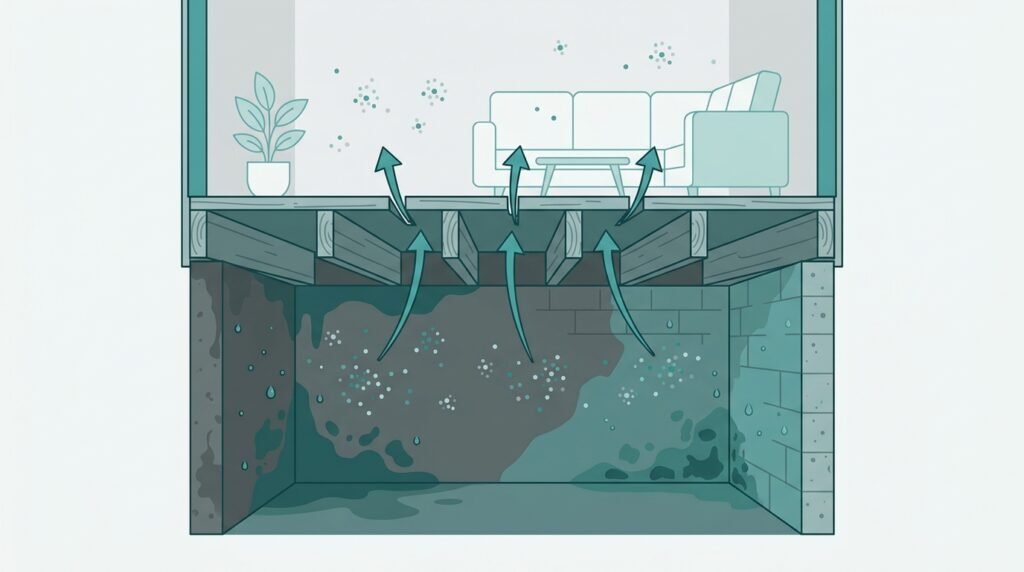
Damp is the common cause behind several of these. It supports mould, it raises endotoxin levels, and it draws in cockroaches and rodents, which need moisture. So fixing the damp addresses more than one trigger at once, which is a better argument for doing it than any single mechanism.
The smell predicts risk better than the stain
A meta-analysis of children developing asthma looked at several damp indicators separately, and the ranking is not the one you would guess.
| Indicator | Increased odds of developing asthma |
|---|---|
| Mould odour | 1.73× |
| Dampness | 1.33× |
| Visible mould | 1.29× |
| Water damage | 1.12× — not statistically significant |
Age matters too. The same work put the effect at 1.99× in infants, 1.30 in children and 1.19 in adults. A 2024 meta-analysis of 32 studies found living in mouldy homes in childhood associated with later asthma, with case-control studies giving 1.53 and cohort studies 1.15.
Two honest notes. The gap between those last two figures is what you would expect if some of the case-control result is recall bias. And for causing asthma the evidence is association-level; earlier review work rated mould-specific causation as inadequate. Damp flaring existing childhood asthma is the causal finding. Damp causing asthma is the weaker claim.
What the guidelines say actually works
The 2020 US national asthma guidelines assessed indoor allergen interventions and graded each one. This table appears on no other page about damp basements, and it changes what you should spend money on.
| Intervention | On its own | As part of doing several things at once |
|---|---|---|
| Air filtration systems and air purifiers | Makes no difference | Makes no difference |
| Impermeable pillow and mattress covers | Makes no difference | Evidence favours it |
| Integrated pest management | Evidence favours it | Evidence favours it |
| Mould mitigation | Not enough studies existed | Evidence favours it |
| HEPA vacuum cleaners | Insufficient evidence | Evidence favours it, in children |
| Carpet removal | Insufficient evidence | Makes no difference |
| Acaricides (anti-mite chemicals) | Insufficient evidence | Makes no difference |
The panel’s summary is blunt: single-component approaches to mitigating an allergen are rarely effective, and for most of these interventions the certainty of evidence is low and the benefits are small.
Four recommendations worth knowing
- If you have asthma but are not sensitised to a specific indoor allergen and have no symptoms on exposure, the guidelines recommend against allergen mitigation as routine asthma management.
- If you are sensitised or have symptoms tied to exposure, do several things at once rather than one.
- For cockroaches and rodents, integrated pest management is endorsed on its own.
- Mattress and pillow covers are recommended only as part of a package, explicitly not as a single measure.
There is a genuine conflict between guidelines here that nobody publishes. An allergy practice parameter gives mattress encasings a strong recommendation. The 2020 asthma guidelines grade covers alone as moderate-certainty no benefit. Both are real guidelines from serious bodies. The reconciliation is that encasings do reduce allergen exposure but do not, alone, change asthma outcomes.
The dust mite number, and the catch
Mite control is genuinely humidity-driven, and the target is specific: keep relative humidity between 35% and 50%. Mites take up water from the air and need around 65% to do it, with survival and reproduction falling below 50%.
Now the catch, which changes what you buy:
If the humidity increases for as little as 1.5 hours per day, as could occur during cooking or bathing, the mites can survive. An elevated RH for as briefly as 3 hours per day permits mites to produce eggs.
So the target is not “under 50% on average”. It is under 50% continuously. Homes where humidity is held steadily in that band have lower mite allergen than homes where it fluctuates, and that is an argument for a properly sized dehumidifier running on a humidistat rather than a bigger one running intermittently.
The same source makes a point about air conditioning that matters: an oversized unit cools the air too quickly and may not run long enough to remove moisture.
But mites are not really a basement problem
Worth being straight about this, because the logic gets muddled. Dust mites live where people shed skin, which means beds and soft furnishings. Your basement dehumidifier is fighting mould.
Unless the basement is a bedroom, or shares conditioned air with one, basement humidity control is not mite control. Mite control has to happen where the bed is.
Things not worth your money
- An air purifier for the basement. Graded as making no difference both alone and within a package. HEPA vacuums are a different product and do have supporting evidence in children.
- Anti-mite sprays. The panel does not recommend acaricides, citing lack of benefit and potential harm from applying chemicals.
- Ozone generators. Ineffective against biological pollutants at safe concentrations, and ozone damages the lungs. For an asthmatic this is worse than doing nothing.
- Spore count testing. If you can see or smell it, sampling is generally unnecessary, and there is no standard to compare a result against.
- Routine bleaching. Not recommended as routine practice, and cleaning products can themselves trigger asthma.
One correction to something this site said previously. You will often read that up to half the air you breathe upstairs comes from the basement. Air genuinely does move upward through a house, and that is a fair reason to care about basement air quality. But we could not find a primary source for the fifty percent figure. It traces to waterproofing company marketing, and we should not have repeated it.
What to tell a doctor
The exposure history matters more than any test. Guidelines direct clinicians to take a history of symptoms and exposures for everyone with asthma to decide whether mitigation is worth doing at all.
- A symptom or peak flow diary keyed to time spent in the basement.
- An actual humidity reading from the basement, not an impression.
- Whether symptoms change when you are away from the house for a week or more.
- Whether anyone in the house is a child, since the causal evidence is strongest there.
Appropriate testing is a skin prick test or a blood test for specific IgE to the allergen in question. And one caveat that is genuinely useful:
For an individual whose symptoms worsen on exposure to specific aeroallergens, the Expert Panel recommends that the clinician consider mitigating that aeroallergen even if the individual’s test result is negative.
A negative allergy test does not close the question. If your chest is worse in the basement, that observation still counts.
What to actually do
- Find and fix the moisture source. This is the intervention with trial evidence behind it, and it addresses mould, endotoxin and pests together.
- Hold humidity between 30 and 50%, continuously.
- Remove mouldy porous material rather than cleaning it.
- Deal with pests properly if there is any sign of them. This is the one thing endorsed on its own.
- Do several of these together. That is the specific finding: packages work, single measures usually do not.
- Get tested if you have not been, so you know whether any of this is asthma therapy or just good building maintenance.
On expectations, the guidelines are candid about the size of the benefit, describing it as small and noting that these interventions may be expensive or difficult to maintain. That is a more honest framing than you will get from anyone selling the fix.
FAQ
Will fixing the basement improve my asthma?
Possibly, and the best evidence for it comes from remediation trials rather than from any single product. Repairing mould-damaged homes reduced wheeze and rhinitis at twelve months. Judge it over a year, not a fortnight.
My child has asthma and we have a damp basement. How worried should I be?
This is the strongest evidence tier on the page: damp exacerbating asthma in children is graded causal. It is a reason to fix the damp with some urgency, and to mention the basement to your paediatrician.
Should I stop using the basement?
If time down there reliably makes symptoms worse, reduce it while you fix the problem. That is a sensible interim measure, not a solution.
Is basement carpet a problem?
It holds moisture and allergen, and in a damp basement it is a poor choice. But carpet removal on its own was graded as making no difference to asthma outcomes, so remove it for moisture reasons rather than expecting it to fix breathing.
Do dehumidifiers help asthma?
Indirectly, by controlling the conditions mould and mites need. The dehumidifier is not the treatment; the dry basement is. And it only counts if humidity stays down rather than averaging down.